Jacket
A long child's vest of 1840–70 in cream leather with red vertical bands, two rows of metal buttons and inset pieces of mica. Full commentary ↓
Couldn't load the puzzle image.
Turn on piece outlines to see piece positions on this picture too
Drag the pieces into place · When zoomed in, drag an empty spot to move around
You can also play with a keyboard — Tab to the board, thenSpace pick a piece, Arrow keys move it (with Shift for small steps),Esc deselect, R rotate a piece (Shift+R the other way)
Jacket is a textile by an unknown maker (1840–70) in the collection of The Metropolitan Museum of Art. It measures 77.5 cm.
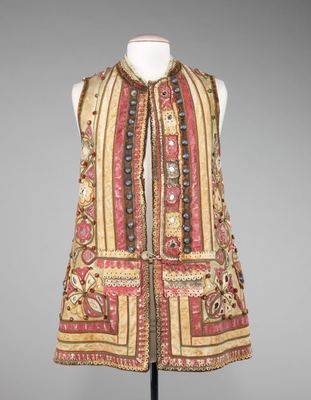
In the pictureThis is a long sleeveless vest shown on a mannequin. Over finely crazed cream leather, several vertical strips of faded pinkish leather are applied and edged with thin green and red cords. On both sides of the front opening, round gray metal buttons line up in two rows of about fifteen each, and beside and below them, set in floral motifs, are pieces of mica that shine like mirrors. The edges are trimmed with overlapping leather cut into round loops, and there are bands of brown fur at the neck and armholes. At the lower sides, wavy leather strips overlap where the pockets are.
BackgroundAccording to the record, the materials are leather, mica and metal, the back length is 77.5 cm, and the date is 1840–70. Though it is called a jacket, it is classified as children's outerwear, so this long vest that covers the hips is recorded as a child's garment. Mica is a transparent mineral that peels off in thin layers, and it was used to create sparkle in place of costly mirrors or metal. Small red and green bobbles are dotted around the floral motifs. It comes from the Brooklyn Museum's 1920–21 collecting expedition and is several decades older than the 1887 jacket from the same expedition. Its accession number is 2009.300.53.
Puzzle tipThe two rows of metal buttons and the red vertical bands form the vertical axis, so start with these lines. The mica pieces can look white or black depending on the reflection, so find them by the shape of the surrounding floral motifs rather than by color. The large floral ornaments at the lower sides and the wavy pocket strips are the reference for the bottom, and the looped edging draws the outline. The mannequin and black stand showing through the open front form the center line. The white mannequin and gray background go last. 100 pieces works well.
- Classification
- Outerwear-Childrenswear
- Medium
- leather, mica, metal
- Dimensions
- 77.5 cm
- Credit line
- Brooklyn Museum Costume Collection at The Metropolitan Museum of Art, Gift of the Brooklyn Museum, 2009; Museum Expedition 1920, 1921, Robert B. Woodward Memorial Fund, 1921
Source: The Metropolitan Museum of Art ↗
Stories about this work
- Six Hungarian Shepherds' Leather Winter Garments in a European Decorative Arts Department
They sit in the Met's European Decorative Arts department, but they are actually shepherds' clothing from the mountain regions of Hungary and Slovakia. Six winter festival garments of leather, wool and mica.
Puzzles to try next
More European Embroidery & Costume puzzles· Stories and puzzle tips