Six Hungarian Shepherds' Leather Winter Garments in a European Decorative Arts Department
Published · updated
A vest of black leather appliquéd with red cloth flowers, a cape with curly black fleece around the neck, a vest glittering with rows of mica pieces. With leather, mica, wool and metal listed side by side among the materials, they hardly seem to fit a “European Decorative Arts” department. These six garments are winter clothes once worn by shepherds in the mountain regions of Hungary, Slovakia and Romania. All come from a costume collection the Brooklyn Museum assembled on expeditions in the early 1920s, and they are now at The Metropolitan Museum of Art.
| Work | Materials | Period |
|---|---|---|
| Jacket (vest) | Leather, wool, glass, metal | 1887 |
| Mantle | Wool, leather, metal | Late 19th century |
| Cape | Leather, wool | 1840–70 |
| Jacket (vest) | Leather, mica, metal | 1840–70 |
| Vest (two children’s vests, one photo) | Leather, wool | Late 19th century |
An appliquéd leather vest
 Solve this painting as a puzzle → about 5 minutes on Easy
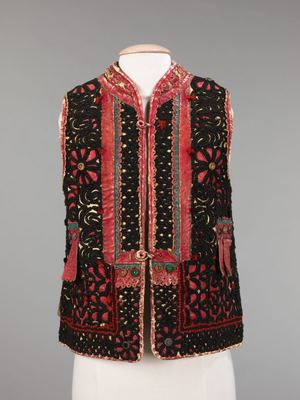
The first Jacket is a jacket in name only; it is closer to a sleeveless vest. Red cloth is cut into flower shapes and appliquéd onto a black leather ground, with gold thread and small pieces of glass set on top. Appliquéing colored cloth onto leather was a technique used by leatherworkers in Hungary and Romania. It is faster than embroidery and stands out well from a distance. Given that the precise year 1887 has survived, the year of making was probably written inside the garment, or a collection record survived.
The black ground and red pattern are distinct, so it is a fairly easy puzzle to solve. Put together the red band along the front opening, the neckline and the tassel pieces at the pockets first, then place the red flowers with left-right symmetry.
A coat also given as a betrothal gift
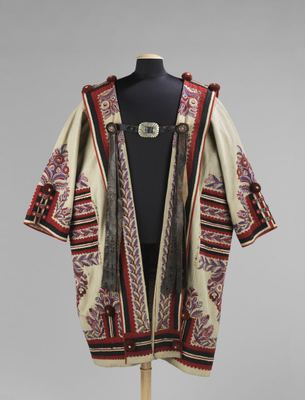
The Mantle has bands of red and purple floral embroidery running along the front opening, sleeves and hem of an off-white wool ground. There is a metal buckle at the neck, and black leather tassels hang at the front. The szűr worn by shepherds of the Great Hungarian Plain was a coat of thick wool cloth with embroidery, worn draped like a cloak without putting the arms through the sleeves. In the 19th century it was also exchanged as a betrothal gift. The shape, embroidery and leather tassel decoration of this garment closely resemble that tradition. When solving it, center the buckle at the neck and the black tassel pieces, wrap the front opening and sleeves with the embroidered bands, then fill in the off-white pieces.
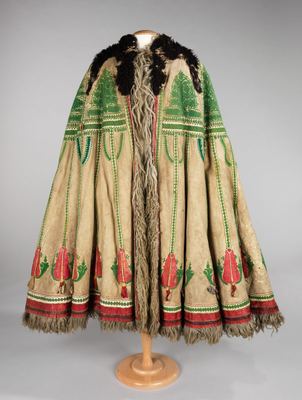
The Cape was made in 1840–70 and is a little older. Off-white leather is densely embroidered with leaf patterns in green thread, a band of red floral embroidery runs along the bottom, and curly black fleece is attached around the neck. Turning a sheepskin so the fleece is on the inside and embroidering the outer surface is typical of garments worn for winter festivals and weddings in Hungary, Slovakia and Romania. Where and how the embroidery was placed marked the region and the workshop, and the black fleece at the neck was the most expensive part. In the puzzle, use that black fleece and the red band at the hem to fix top and bottom, and join the green embroidery by following the direction of the pattern.
A vest that glitters with mica
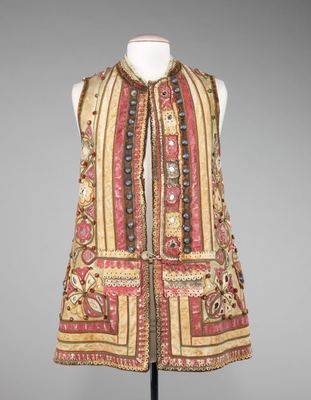
The second Jacket is also, despite its name, a long sleeveless vest. Red cloth is applied in vertical strips on off-white leather, with round metal buttons and small pieces of mica set in rows on top. Mica is a transparent mineral that peels off in thin sheets, and it was used on country clothing to create sparkle in place of expensive mirrors or metal. Applying cloth and setting decorations was sturdier than embroidery, so the garment could be worn for a long time. The red vertical strips and rows of metal buttons form a vertical axis, so in the puzzle, too, start by setting up those lines.
Two children’s garments in one photograph
The last two pieces are children’s vests photographed side by side in a single photograph. They have two separate accession numbers, but the photograph is the same, so on this site they are solved together as one puzzle.
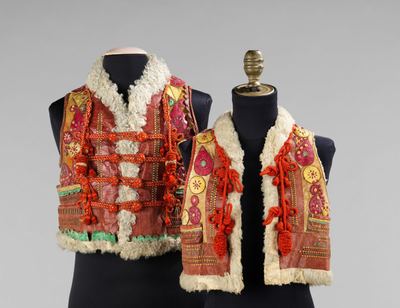
The two children’s vests are both sheepskin vests edged with curly white fleece, but they look quite different. The one on the left closes its reddish-brown leather body with four rows of orange cord loops and round knot buttons, and yellow and magenta leather is appliquéd in teardrop and flower shapes across the upper chest. The one on the right is open at the front, with the fleece front edges turned back. Magenta teardrops are applied on a yellow leather panel, and knots of twisted red cord end in large pinecone-shaped tassels. According to the records, the back lengths are 38.1 cm and 48.3 cm, so they may have been the clothes of two children of different ages. The records do not say which one in the photograph has which number.
Outline the two vests separately first using the white fleece edging, then fill in the insides using the rows of orange cord loops on the left and the pinecone tassels on the right as reference points. For all six garments, 48 to 100 pieces is about right.
The department name and what the clothes really are
The Met’s “European Decorative Arts” department covers not only painting and sculpture but folk crafts from all over Europe. That a Hungarian shepherd’s leather clothing sits in this department is not strange in itself. Still, there is this much distance between what you picture from the list of materials and what the garments actually are. Another thing the six have in common is that they were made not with paint but with three-dimensional materials: leather, mica and fleece. Seen alongside the European folk costume covered in things worn on the head, that country attire comes into much fuller relief.
The maker’s name appears nowhere. The reason that almost half the works on this site are by unknown artists repeats itself here as well. The difference shows more clearly when compared with the girls of the embroidered samplers who stitched their names to leave them behind. Clothing like this was meant from the start to carry on the traditions of a village and a workshop rather than one person’s signature.
In the mountain villages of preindustrial Europe, someone appliquéd flowers and set mica into a single vest to wear to a winter festival. That care has survived more than 100 years in a museum collection, and now it is being pieced together again on screen.