Jacket
A short top with gold-thread embroidery and rows of round buttons: a formal garment made in early 19th-century Tunisia, according to the Met's records. Full commentary ↓
Couldn't load the puzzle image.
Turn on piece outlines to see piece positions on this picture too
Drag the pieces into place · When zoomed in, drag an empty spot to move around
You can also play with a keyboard — Tab to the board, thenSpace pick a piece, Arrow keys move it (with Shift for small steps),Esc deselect, R rotate a piece (Shift+R the other way)
Jacket is a textile by an unknown maker (early 19th century) in the collection of The Metropolitan Museum of Art.
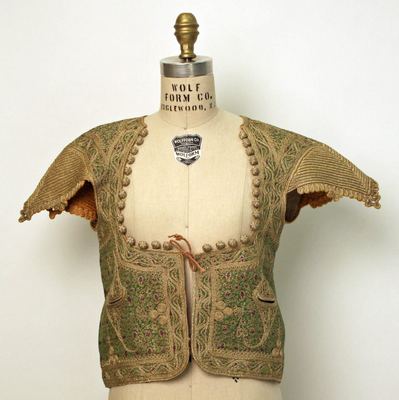
In the pictureThis is a short jacket shown on a mannequin. Scrolling vines are embroidered in green and gold thread, rows of metal buttons run down both sides of the front opening, and a red cord is tied across the chest. The short sleeves are also densely embroidered, and the front ends above the waist.
BackgroundThe Met's record lists this garment as a vest made in Tunisia in the early 19th century. In Tunisia, then within the Ottoman Empire's sphere of influence, short tops like this were worn layered over a long undergarment. The metallic-thread embroidery and button decoration indicate a garment for weddings or festivals, and such clothes were property handed down from mother to daughter. The embroidery on the sleeves runs in a different direction from that on the body because each part was embroidered separately and then joined.
Puzzle tipMost pieces are gold embroidery, but the rows of buttons on the front, the red cord, and the pieces with the mannequin's white neck and torso are good reference points. The sleeve pieces can be told from the body pieces because their embroidery runs horizontally. 100 pieces works well.
- Classification
- Main dress
- Medium
- Silk, metal wrapped thread; brocaded and embroidered
- Dimensions
- Overall:
- Credit line
- Gift of Kate Fowler Merle-Smith, 1941
Source: The Metropolitan Museum of Art ↗
Stories about this work
- A Tunic Reduced to Its Collar and Two Shirts from India
A short Tunisian vest, a collar detached from a tunic, a crimson silk shirt from India, and an ocher child's garment. Four costumes from the Met's Department of Islamic Art, assembled as puzzles.