A Tunic Reduced to Its Collar and Two Shirts from India
Published · updated
A single piece of black wool cut in a U shape is dense with gold thread. It was originally a collar wrapped around the neckline of a tunic, but the garment has disappeared somewhere and only this part remains in the museum. I have toured a fair amount of the costumes in the Met’s Department of Islamic Art in women’s dresses from the Islamic world and tops distinguished by their shapes, but there were still four pieces I had not touched. A short jacket from Tunisia, a collar detached from a tunic, and two shirts from India.
| Work | Form | Period |
|---|---|---|
| Jacket | Short vest-style top (Tunisia) | Early 19th century |
| Plastron (Collar) from a Tunic | Collar detached from a tunic (Tunisia) | 19th century |
| Child’s Shirt | Open-front short-sleeved child’s garment (India) | 19th century |
| Shirt | Woman’s shirt (India) | Late 19th century |
A Tunisian jacket covered in gold thread
 Solve this painting as a puzzle → about 5 minutes on Easy
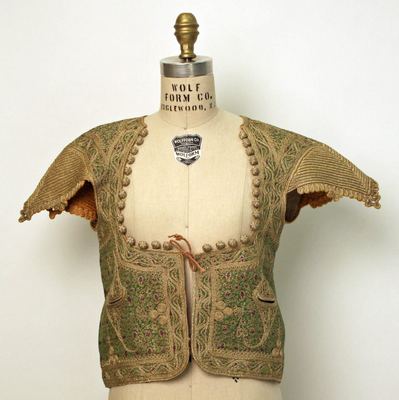
Jacket is embroidered with vine patterns in green and gold thread, and metal buttons are lined up along the front opening. The embroidery is dense even on the short sleeves, and the front ends above the waist. The Met’s records list it as a vest made in Tunisia in the early 19th century. In Tunisia at the time, under the influence of the Ottoman Empire, short tops like this were worn layered over a long undergarment. Judging from the metal-thread embroidery and button decoration, it was worn for weddings or festivals, and garments like this were property passed down from mother to daughter. The embroidery on the sleeves runs in a different direction from that on the body because each part was embroidered separately and then joined together.
Why the collar survives without the garment
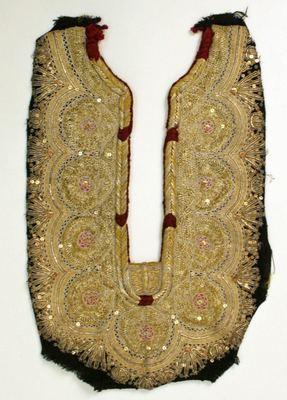
Plastron is the U-shaped collar mentioned above. It is embroidered all over with flowers and scrolls in gold thread, with red thread and small sequins set here and there. According to the Met’s records, it is a 19th-century object from Tunisia like the jacket, made with metal-wrapped thread and glass on a black wool ground. A plastron is a decorative panel attached at the chest of a garment. Wedding garments in North Africa and the Middle East concentrated gold thread in this spot rather than across the whole garment, richly adorning the area around the face. When a garment wore out, the collar alone was removed and transferred to a new garment or kept separately. That is why so many collars survive today without their garments.
An ocher child’s garment and a crimson shirt
According to the Met’s records, the other two are both 19th-century silk garments made in India. One is a child’s and one an adult’s, but what differs more than their size is the ground color and the way they are embroidered.
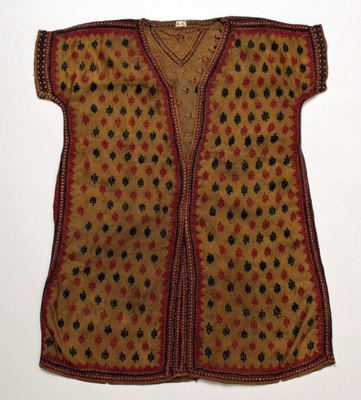
Child’s Shirt is open at the front and has short sleeves. Across the whole ocher silk body, small diamond-shaped flowers with stepped outlines run in rows, alternating navy and red. The edges, front opening, and sleeve ends are bordered with a band of linked V shapes in white, red, and black thread. The sleeves end just past the shoulders, so it looks almost like a vest. It is 54 centimeters high and 43.8 centimeters wide.
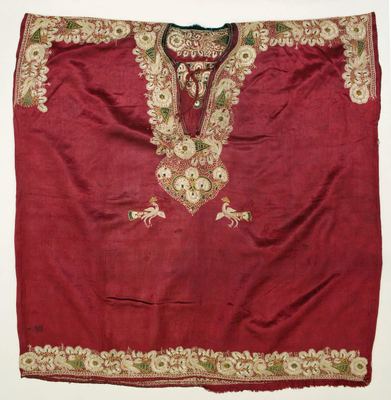
Shirt is a woman’s shirt of crimson silk that becomes almost square when laid flat. Embroidered bands of cream-colored flowers and green cone motifs run around the keyhole-shaped neck opening, across both shoulders, and along the hem. On either side of a medallion hanging below the opening, two crested peacocks face each other. It is 66 centimeters long and 65.1 centimeters wide, and it was donated in 1956. If the child’s garment fills its body without a gap with small patterns, this shirt concentrates its decoration at the neck, shoulders, and hem and leaves the broad red areas empty. The peacock is a bird motif long used in Indian art. The records do not say on what occasions either garment was worn.
Start with the U-shaped curve and the two peacocks
The jacket is mostly gold embroidery pieces, so it looks daunting, but the row of buttons along the front opening, the red cord, and the mannequin’s white neck make solid reference points. The sleeve pieces can be told apart from the body because the grain of their embroidery lies horizontally, so it is worth trying at 100 pieces. For the collar, the U-shaped curve itself is the shape clue. Put the outer curve pieces around first, then fill in the inside by how dense the gold-thread pattern is.
The adult’s shirt is easy to solve because the red ground and cream embroidery separate clearly. Assemble the medallion and the two peacocks below the neck opening first, outline it with the embroidered bands at the shoulders and hem, then fill in the red interior. In the child’s shirt, the same pattern repeats across the entire body, so the pieces resemble one another. Set up the frame first with the V-shaped band at the edges, the front opening in the middle, and the tag at the neck. The child’s shirt is comfortable at up to 48 pieces, the adult’s shirt at up to 100.
Where the effort went
Grouped together, the four layer two stories over each other. The jacket and collar show which part of a garment received the most care. The two shirts give different answers, for the same kind of silk garment, about where and how much decoration to place. One fills its body with small patterns, and the other gathers its patterns only at the borders. More than a garment surviving whole, cases like these, where only one part survives or the placement of decoration diverges, reveal more clearly what the garment cared about.
The story of costume from the Islamic world moves on to layered clothing from the Balkans. There, the main subject is the practice of wearing many garments at once. The people who made these four pieces also remain unknown artists. Still, the garments themselves tell us what was kept and where gold thread was not spared. A single collar that lost its garment and has endured for more than a hundred years is the proof.