Joséphine-Éléonore-Marie-Pauline de Galard de Brassac de Béarn (1825–1860), Princesse de Broglie
A young princess in a pale blue satin gown leans on a chair: one of Ingres's last portraits, rendering fabric, pearls and gilded chair down to the finest detail. Full commentary ↓
Couldn't load the puzzle image.
Turn on piece outlines to see piece positions on this picture too
Drag the pieces into place · When zoomed in, drag an empty spot to move around
You can also play with a keyboard — Tab to the board, thenSpace pick a piece, Arrow keys move it (with Shift for small steps),Esc deselect, R rotate a piece (Shift+R the other way)
Joséphine-Éléonore-Marie-Pauline de Galard de Brassac de Béarn (1825–1860), Princesse de Broglie is an oil painting by Jean Auguste Dominique Ingres (1851–53) in the collection of The Metropolitan Museum of Art. It measures 121.3 × 90.8 cm.
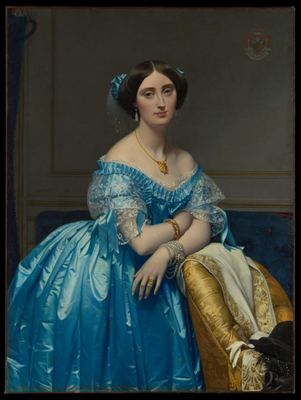
In the pictureA young woman in a pale blue satin gown stands with her arms resting on the back of a gilded chair. Black hair, a pearl necklace, a bracelet and earrings. On the chair lie white gloves and a fan. The folds and sheen of the gown, the lace and every single pearl are painted to look more real than the real thing. Her face is calm and a little sad.
BackgroundPainted in 1853, it portrays Pauline, the 28-year-old wife of the duc de Broglie. Ingres was 73, and this was one of his last portrait commissions. The princess died of tuberculosis seven years later, and her husband is said to have kept this painting behind a curtain for the rest of his life. Ingres often stretched the body to suit the beauty of line rather than anatomy, and the arms and neck in this painting are no exception.
Puzzle tipThere are five colors: the blue gown, flesh, black hair, the gilded chair and the gray wall. Start with the face and jewelry, and divide the gown by the direction of its folds. The wall pieces are almost a single color, so leave them for last. The gilded chair pieces are good clues because their pattern continues from piece to piece.
- Artist
- French, Montauban 1780–1867 Paris
- Classification
- Paintings
- Medium
- Oil on canvas
- Dimensions
- 121.3 × 90.8 cm
- Credit line
- Robert Lehman Collection, 1975
Source: The Metropolitan Museum of Art ↗
Puzzles to try next
More Robert Lehman Collection puzzles· Stories and puzzle tips