The Birth and Naming of Saint John the Baptist
Elizabeth in bed, women bathing the baby and Zacharias writing a name on a tablet: Sano di Pietro's narrative scene from the strip beneath an altarpiece. Full commentary ↓
Couldn't load the puzzle image.
Turn on piece outlines to see piece positions on this picture too
Drag the pieces into place · When zoomed in, drag an empty spot to move around
You can also play with a keyboard — Tab to the board, thenSpace pick a piece, Arrow keys move it (with Shift for small steps),Esc deselect, R rotate a piece (Shift+R the other way)
The Birth and Naming of Saint John the Baptist is a tempera and gold painting by Sano di Pietro (ca. 1450–55) in the collection of The Metropolitan Museum of Art. It measures 24.4 × 47.9 cm.
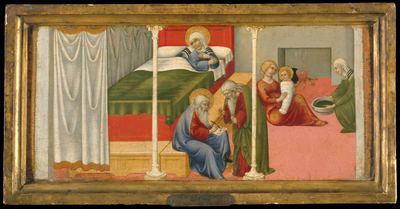
In the pictureThe wide horizontal picture is divided into two rooms. In the left room a woman lies in a bed hung with white curtains, and in front of her an old man writes on a tablet resting on his knees. In the right room, women in red hold the baby and prepare to bathe him. The red of the columns and floor and a gilded frame surround the picture.
BackgroundThis is the story of the birth of John the Baptist. His father Zacharias lost his speech because he did not believe the angel's words, and he is said to have spoken again after writing "John" on a tablet once the child was born. Sano di Pietro was the painter who received the most commissions in 15th-century Siena, and this painting is one of several scenes set in the lower strip (the predella) of a large altarpiece. By placing two rooms side by side, he fit the passage of time into a single picture.
Puzzle tipBecause the picture is wide, the pieces come out wide and short. Gather the white curtain and bed pieces, the red floor pieces and the gilded frame pieces separately, and divide the two rooms with the vertical line of the central column. The faces are small, but the gold circles of the halos show where they go.
- Artist
- Italian, Siena 1405–1481 Siena
- Classification
- Paintings
- Medium
- Tempera and gold on wood
- Dimensions
- 24.4 × 47.9 cm
- Credit line
- Robert Lehman Collection, 1975
Source: The Metropolitan Museum of Art ↗
Stories about this work
- Why Early Renaissance Altarpieces Have Gold Backgrounds: Reading the Lehman Panels
Why is the background of every gold-ground panel in the Robert Lehman Collection gold? Early Renaissance painting, explored by putting the panels together as puzzles.
Puzzles to try next
More Robert Lehman Collection puzzles· Stories and puzzle tips