No te aha oe riri (Why Are You Angry?)
Women and chickens gathered in front of a hut in a Tahitian village: painted by Gauguin in 1896, during his second stay in Tahiti. Full commentary ↓
Couldn't load the puzzle image.
Turn on piece outlines to see piece positions on this picture too
Drag the pieces into place · When zoomed in, drag an empty spot to move around
You can also play with a keyboard — Tab to the board, thenSpace pick a piece, Arrow keys move it (with Shift for small steps),Esc deselect, R rotate a piece (Shift+R the other way)
No te aha oe riri (Why Are You Angry?) is an oil painting by Paul Gauguin (1896) in the collection of The Art Institute of Chicago. It measures 95.3 × 130.5 cm.
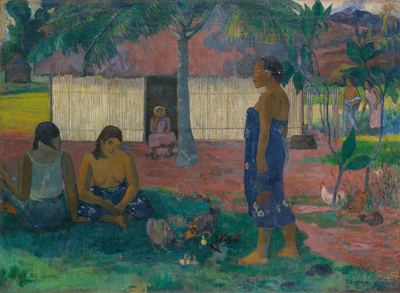
In the pictureBeyond a yard of red earth, a hut with yellow bamboo walls and a red roof stretches across the picture. In the dark doorway sits a woman in pink with her chin in her hand, and in front of the hut a tree with a gray trunk spreads its leaves above. On the grass at the front left sit two women: one shows her back at an angle, and the other, bare above the waist and wrapped in patterned blue cloth, bows her head. On the right a woman with a white flower in her hair and blue cloth wrapped around her body stands looking toward the seated women. At their feet are chickens and chicks, and two women stand farther back on the right. The title of the painting is written at the lower left and the signature at the lower right.
BackgroundGauguin first went to Tahiti in 1891 and stayed a little over two years before returning to Paris, but when he did not win the recognition he had hoped for, he left again for Tahiti in 1895 and never returned to France. This painting dates from 1896, the year after his second stay began. The title means "Why are you angry?" in Tahitian, but who in the picture is saying it to whom is not revealed. Gauguin often wrote Tahitian phrases directly on the canvas like this and used them as titles. He painted it not on fine canvas but on coarse jute.
Puzzle tipThe areas of color are large and distinct, so sorting is easy. First join the yellow bamboo walls of the hut as a horizontal band, then add the dark doorway in the middle, the woman in pink and the gray tree trunk in front. Next, fit the standing woman's blue cloth and the two women on the left. The ground divides diagonally into red earth and green grass: the red earth is in front of the hut and on the right, and the grass is at the bottom. The chickens are small, so look for them together with the surrounding ground pieces. Fill in the green leaves and red hillside at the top last. 48 pieces is a good fit.
- Classification
- Painting
- Medium
- Oil on jute canvas
- Dimensions
- 95.3 × 130.5 cm
- Credit line
- The Art Institute of Chicago, 1933.1119
Source: The Art Institute of Chicago ↗
Stories about this work
- 17 Must-See Paintings at the Art Institute of Chicago, from Seurat's Dots to American Gothic
Seurat's A Sunday on La Grande Jatte, Caillebotte's Paris Street; Rainy Day, Van Gogh's The Bedroom and Grant Wood's American Gothic. The stories of 17 must-see paintings at the Art Institute of Chicago, what to check before you go, and how to meet them first as puzzles.