Paddle Doll
A doll with a flat wooden body and hair of mud beads on strings: a Middle Kingdom "paddle doll," thought to be a fertility charm placed in tombs. Full commentary ↓
Couldn't load the puzzle image.
Turn on piece outlines to see piece positions on this picture too
Drag the pieces into place · When zoomed in, drag an empty spot to move around
You can also play with a keyboard — Tab to the board, thenSpace pick a piece, Arrow keys move it (with Shift for small steps),Esc deselect, R rotate a piece (Shift+R the other way)
Paddle Doll is a textile by an unknown maker (ca. 2030–1802 B.C.) in the collection of The Metropolitan Museum of Art.
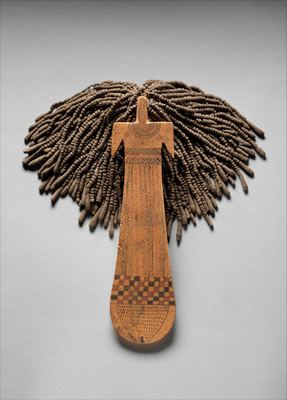
In the pictureGrids and lines are painted on a long, flat wooden board shaped like a paddle, and from the top dozens of strings threaded with mud beads hang down like hair. A necklace and the patterns of a garment are drawn in black lines on the body, and there are no arms or legs. The body is 23 cm long.
BackgroundCalled a "paddle doll" because of its paddle shape, this figure was not a child's toy but a tomb offering, regarded as a charm for fertility and rebirth. The wide hips and the patterns on the body represent a woman's body, and one interpretation holds that the bead hair imitates the wigs of dancers of the time. Several have been found in tombs at Thebes.
Puzzle tipThe bead-hair pieces have a distinct texture and are easy to pick out, and the grid-patterned pieces of the wooden body are fitted by the direction of the pattern. The background is plain gray, so placing the doll's outline pieces first narrows down the inside. 24 or 48 pieces is a good fit.
- Period
- Middle Kingdom
- Dynasty
- Dynasty 11, late-12
- Medium
- Wood, mud, linen string, paint
- Dimensions
- Body: H. 22.8 cm (9 in.); W. 7 cm (2 3/4 in.); Th. 0.9 cm (3
- Credit line
- Rogers Fund, 1931
Source: The Metropolitan Museum of Art ↗
Stories about this work
- Two Dolls from Egyptian Tombs That Look Like Toys but Were Amulets
A flat doll shaped like a paddle and a painted wooden figure the size of a finger. They look like children's toys, but they were amulets of fertility and rebirth placed in tombs.