Two Dolls from Egyptian Tombs That Look Like Toys but Were Amulets
Published
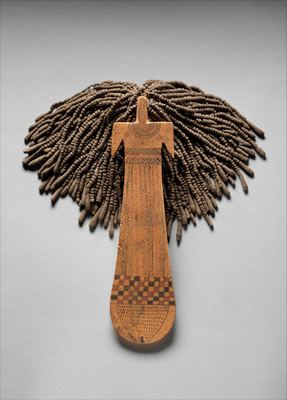
A doll made of a flat wooden board, with strings of beads hanging down like hair. At first glance you might wonder whether it was a toy an ancient Egyptian child played with. But this doll came from a tomb. Egyptian Art also includes boat models for the dead’s journey to the afterlife, but boats were not the only things that went into tombs. Small dolls praying for fertility and rebirth were buried as well, and the two here are such objects.
| Work | Form | Material | Size | Period |
|---|---|---|---|---|
| Paddle Doll | Flat board | Wood, mud, string, paint | Body 23cm | Dynasty 11 to late Dynasty 12 |
| Statuette | Three-dimensional figure | Wood, paint | 15cm | Middle Kingdom to early New Kingdom (Dynasty 11) |
A paddle-shaped body with beaded hair
 Solve this painting as a puzzle → about 5 minutes on Easy
Paddle Doll is a long, flat wooden board shaped like a paddle, painted with patterns, with strings of mud beads tied at the top to serve as hair. Its shape is why it is called a “paddle doll,” but its use was far from that of a toy. It was a grave good placed in a tomb and is regarded as an amulet praying for fertility and rebirth.
The broad hips and the patterns on the body represent a woman’s body. One interpretation holds that the beaded hair imitates the wigs of dancers of the time. A single simple board without arms or legs thus holds both a woman’s body and dance. Several dolls like this have come from tombs at Thebes.
Fifteen centimeters that lost its face
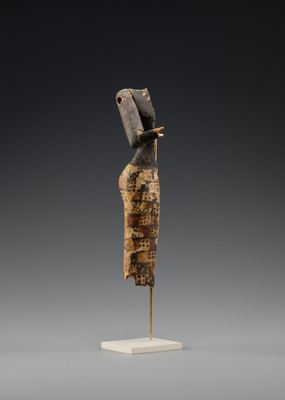
Statuette is a wooden figure only 15 centimeters tall. The head is painted black, and the face is broken. In its place, the colorful skirt pattern painted in red, yellow, and black survives intact.
It may have been part of a tomb model, or it may have been a grave good praying for fertility and rebirth. If the latter, it is a companion that did the same job as the paddle doll. The skirt pattern depicts a garment made of woven beads, so it has something in common with paddle dolls of the same period.
One arm stretches forward, so we can guess that she was holding something or was in a dancing pose. Her expression is gone, but her gesture alone makes us imagine what moment of movement it might have been.
Why dolls were placed in tombs
Both look like toys, but both came from tombs. The ancient Egyptians believed that life continued after death, and they invested that life with a strong hope for fertility and regeneration. The simplified form of a woman’s body and the richly decorated clothing were both meant as prayers for vitality to continue even into the afterlife.
Compare them with Meketre’s boat models and you get a sense of how varied the objects placed in tombs were. If the boats took care of movement and travel, the dolls took care of keeping life from being cut off. To furnish a household in the afterlife completely, grave goods of such different kinds had to be there together.
A gray background and a black background
Both are small and simple, so they come together quickly. In the paddle doll, the texture of the beaded hair is distinct and easy to pick out, and for the grid pattern on the body you only need to follow the direction of the pattern. The background is a single gray, so if you first outline the doll, the inside narrows down on its own.
The statuette is a small figure standing in the middle of a dark background, so the only clues are the outline pieces. Assemble the black hair and the patterned skirt first, set up the vertical axis with the light pieces of the rod and stand at the bottom, and fill in the dark background last. Both repeat grid and dot patterns, so sorting the pattern pieces that mix red, yellow, and black by color in advance makes things much faster. For both, 24 pieces is a good piece count. These are small originals enlarged into big images, so keeping the piece count low keeps the details alive.
A wish in the palm of the hand
These two are among the smallest puzzles on the whole site. Next to the other sculptures in the Egyptian art puzzle guide, or the non-royal Egyptian sculptures of people who left their names, they look even smaller. They are small enough to rest in your palm, but the ancient Egyptians’ longing for life after death was not small. Dolls that waited thousands of years in the darkness of tombs are now put back together on the screen, one piece at a time.