Relief with the prince Senwosretankh
The prince Senwosretankh seated in red before a name cartouche: a fragment of early 12th Dynasty limestone relief with traces of paint. Full commentary ↓
Couldn't load the puzzle image.
Turn on piece outlines to see piece positions on this picture too
Drag the pieces into place · When zoomed in, drag an empty spot to move around
You can also play with a keyboard — Tab to the board, thenSpace pick a piece, Arrow keys move it (with Shift for small steps),Esc deselect, R rotate a piece (Shift+R the other way)
Relief with the prince Senwosretankh is a stone object by an unknown maker (ca. 1981–1952 B.C.) in the collection of The Metropolitan Museum of Art. It measures H. 38.1 cm (15 in); W. 33 cm (13 in).
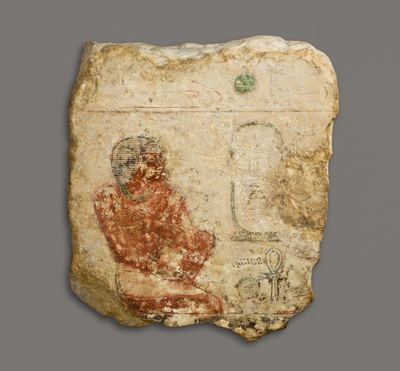
In the pictureOn a broken limestone slab, a man painted red sits in profile. He has short hair and wears a close-fitting garment, and in front of him are carved a cartouche with a name inside its oval border and the ankh, the symbol of life. The red paint survives only in parts, and the edges of the slab are broken.
BackgroundSenwosretankh is the name of a prince, and writing a name inside a cartouche marks him as royalty. This relief comes from near the pyramid temple of Amenemhat I, an example of the king's family appearing in temple decoration. Red skin was the conventional color for men in Egyptian art.
Puzzle tipThe red figure pieces are the most distinct, so fit them first. The pieces with the oval of the cartouche and the shape of the ankh are the next clues, and the rest of the white limestone is placed by the curves of the broken edges. Frame the gray background pieces starting from the outline of the slab. 48 pieces is about right.
- Period
- Middle Kingdom
- Dynasty
- Dynasty 12
- Medium
- Limestone, paint
- Dimensions
- H. 38.1 cm (15 in); W. 33 cm (13 in)
- Credit line
- Rogers Fund, 1909
Source: The Metropolitan Museum of Art ↗
Stories about this work
- Five Stones from the Ruined Temple of Amenemhat I
The pyramid temple of the king who founded the 12th Dynasty has collapsed, but its excavated fragments still record his name, his face, and his co-rule with his son.