A Thousand Years From One Collector: Five Objects From the Kelekian Bequest
Published
In “Medieval Art” there are five objects whose provenance line at the end of the description reads “Bequest of Nanette B. Kelekian, 2020.” They are things a collector left to the museum upon her death. Yet these five objects differ in every way: period, culture, and material. From 6th-century Byzantine ivory to 16th-century Flemish boxwood, a thousand years lie between them.
| Work | Culture | Period | Material |
|---|---|---|---|
| Pyx Fragments with the Multiplication of the Loaves and Fishes | Byzantine | 6th century | Elephant ivory |
| Panel with Lovers | Late Roman/Early Byzantine | 4th–6th century | Bone |
| Pharmacy Jar | Spanish | 14th century | Tin-glazed earthenware |
| Statuette of the Virgin and Child | Franco-Netherlandish | Early 16th century | Boxwood |
| Plaque with Saints Peter and Paul | Byzantine | 14th–15th century | Black steatite |
Early Christian art of the Mediterranean world, late Byzantium, Spain under Islamic rule, the Northern Renaissance. One person’s collection spans this much time and territory. Kelekian’s eye, it seems, did not linger long on any one era.
A miracle carved on a box for the Eucharist
 Solve this painting as a puzzle → about 5 minutes on Easy
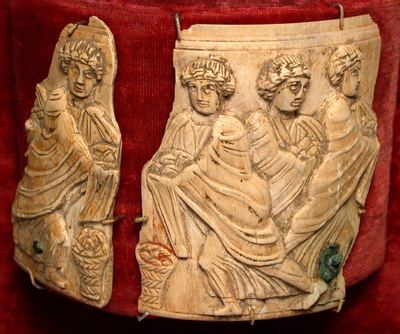
The oldest of the five is Pyx Fragments with the Multiplication of the Loaves and Fishes. A pyx is a small cylindrical box that held the consecrated host (the bread of the Eucharist). In the early Byzantine period, pyxes were made of elephant ivory and carved on the outside with biblical scenes.
The scene carved on this piece is the miracle of feeding the crowd with five loaves and two fish. Its meaning connects with the Eucharist, so it would have been a fitting subject for such a box. Only part of the cylindrical box remains, but the postures of the figures in their draped garments carry on the drapery of late Roman sculpture.
Bone instead of ivory
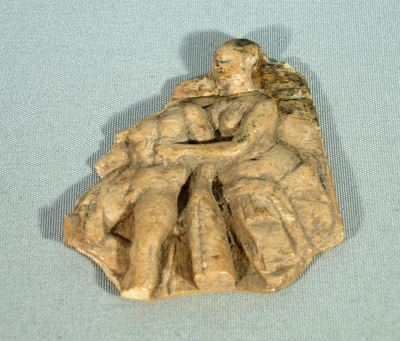
Panel with Lovers is a panel about the size of a palm. A woman leans on a man’s shoulder, and the man wraps his arms around her. Panels like this decorated the outside of wooden boxes and were widely made in the Mediterranean world in the 4th to 6th centuries. There is also a suggestion that panels carved with mythological lovers or married couples were attached to boxes given as wedding gifts.
Compared with the ivory above, the material is of a different rank. Using bone, cheaper than ivory, means it was an everyday object. Even in the same period and the same Mediterranean world, sacred objects were made of ivory and everyday gifts of bone.
A jar from the pharmacy shelf
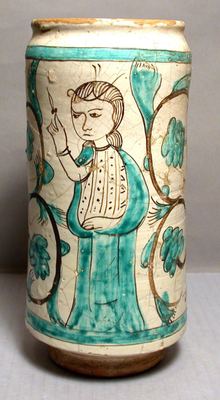
Pharmacy Jar is the only secular, practical object among the five. It is a cylindrical ceramic painted with leafy green vines and a figure, and in a pharmacy it held herbs and ointments. It was made to stand in a row on a shelf and to be easy to grip by hand.
Painting on white glaze with only two colors, copper (green) and manganese (brown), is characteristic of Paterna ware from the Valencia region. Some interpretations read in the figure’s clothing and gestures traces of the mingling of Islamic and Christian cultures in Spain at the time. 14th-century Spain is contained, whole, in this one ordinary pharmacy jar.
A Virgin the size of a finger
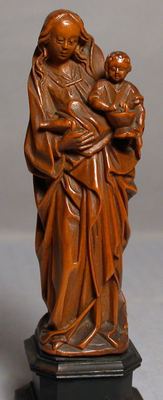
Statuette of the Virgin and Child is the latest in date of the five. It is 9 centimeters tall, carved from boxwood. Boxwood has a very tight grain, so even on a carving the size of a finger, facial expressions and drapery folds could be cut. In early 16th-century Flanders and France, this wood was used for rosary beads and small devotional figures.
It is a statuette that would have been kept on a desk or in a bedroom and used for private prayer. The pose, with the body twisted slightly into an S-curve, is typical of late Gothic statues of the Virgin. Being left unpainted, so that the grain and color of the wood show as they are, is also common in boxwood carvings of this period.
A holy image carried close
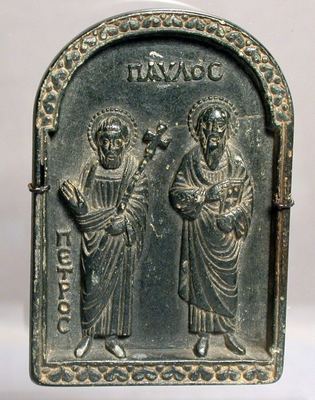
Plaque with Saints Peter and Paul is the latest Byzantine art among the five. The two saints are carved side by side in black steatite. Steatite is a soft, black stone suited to small reliefs, and in the last years of the Byzantine Empire it was widely used for small holy images that individuals carried with them.
Placing Peter and Paul side by side is an old formula signifying the two pillars of the Church. The drapery and lettering show the 14th to 15th century, the final period of Byzantine art. It is a small token of faith that someone carried close as the empire was waning.
Five background colors
All five are small, with surfaces close to a single color, so the method discussed in Small treasures of the Middle Ages works as is. First, sort by the color of the material: yellowish ivory, grayish bone, white glaze, wood-colored boxwood, black steatite. Each background color is distinct, so there is little worry of them mixing.
As reliefs and carvings, they have depth. Following the shadows of the raised parts separates them from the flat background, and since these are objects centered on figures, assembling the silhouette pieces first sorts out the background on its own. The pharmacy jar is a little different. It is a flat photograph of a round jar, so the pattern looks slightly curved; assemble it by following the curves of the vines. We recommend Easy (about 24 pieces) or Normal (about 48). The smaller the object, the lower the piece count should be for the details to come through.
A thousand years side by side
Coming from the same bequest does not mean they are related to one another. Still, lined up in a row, they make a story. From a box for the Eucharist to a wedding gift, from a pharmacy jar to a statue of the Virgin used in private prayer, and then to a small holy image carried close. Seen together with Irish shrine reproductions or Byzantine gold coins, they reveal how many kinds of belief and use medieval people put into objects large and small.
From the 6th century to the 16th, from the eastern Mediterranean to Western Europe. These five objects show that collecting does not stop at gathering things. How one person read world history remains in the objects she chose.