Pileus
An 18th-century pileus, the round skullcap of a Catholic cleric, made of joined pieces of red leather. Given in 1941 together with a biretta. Full commentary ↓
Couldn't load the puzzle image.
Turn on piece outlines to see piece positions on this picture too
Drag the pieces into place · When zoomed in, drag an empty spot to move around
You can also play with a keyboard — Tab to the board, thenSpace pick a piece, Arrow keys move it (with Shift for small steps),Esc deselect, R rotate a piece (Shift+R the other way)
Pileus is a textile by an unknown maker (18th century) in the collection of The Metropolitan Museum of Art.
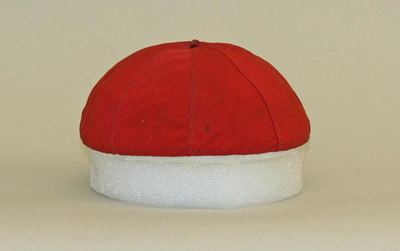
In the pictureAgainst a beige background, a red hemispherical cap sits on a white sponge cylinder stand. Vertical seams joining several pieces meet at a small knotted nub at the top, and a line of stitching also runs around the lower edge. There is no decoration, and one small black stain shows at the center front. The record lists the material as leather, but in the photograph the surface looks even and soft, like cloth. The cap is a little wider than the stand, so its edge sticks out slightly. The photograph was taken straight on at eye level, so the cap looks like a flat dome.
BackgroundPileus is Latin for a brimless cap, and the word is also used for the small round cap (zucchetto) that Catholic clergy wear on the crown of the head. The color of this cap varies with rank, and red belongs to cardinals. However, the collection record does not say who wore it, and while the material is given as leather, the classification is "Textiles-Woven," so the records contradict each other. Agnes Clark gave it in 1941, and its accession number, C.I.41.124.8, runs on to the very next number, a red biretta. The date is given only as the 18th century.
Puzzle tipThere are only three masses, the red cap, the white stand, and the beige background, so 24 pieces is plenty. Assemble the round outline of the cap and the pieces along the edge of the white stand first, then fill in the cap following the direction in which the vertical seams converge on the nub. The black stain on the front marks the center piece. Connect the white stand by the straight line of its lower edge, and tell the background apart by the slight difference between its lighter top and darker bottom.
- Classification
- Textiles-Woven
- Medium
- Leather
- Credit line
- Gift of Miss Agnes Clarke, 1941
Source: The Metropolitan Museum of Art ↗
Stories about this work
- From a Cardinal's Red Cap to a Palestinian Headscarf: Things Worn on the Head
Hats that signal authority, headdresses that tell you a region, a headscarf covered in embroidery. Six pieces of headwear we had never covered before, gathered in one place.
Puzzles to try next
More European Embroidery & Costume puzzles· Stories and puzzle tips