Plaque with Saints Peter and Paul
A black steatite plaque of Peter and Paul side by side under an arch, their names carved in Greek; a small Byzantine icon of the 14th–15th century, 6.5 cm high. Full commentary ↓
Couldn't load the puzzle image.
Turn on piece outlines to see piece positions on this picture too
Drag the pieces into place · When zoomed in, drag an empty spot to move around
You can also play with a keyboard — Tab to the board, thenSpace pick a piece, Arrow keys move it (with Shift for small steps),Esc deselect, R rotate a piece (Shift+R the other way)
Plaque with Saints Peter and Paul is a work by an unknown maker (late 14th–15th century) in the collection of The Metropolitan Museum of Art. It measures 6.5 × 4.4 cm.
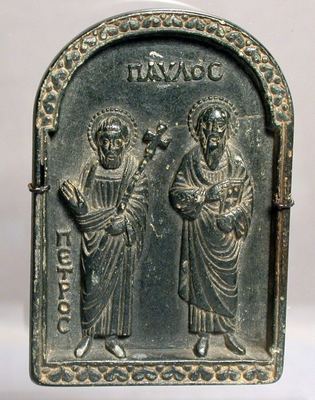
In the pictureTwo saints stand in relief on a black steatite plaque with a rounded, arched top. On the left, Peter, with short curly hair and a round beard, raises his right hand and holds a long cross-staff in his left, and his name, ΠΕΤΡΟΣ, is carved vertically along the left edge. On the right, Paul, with a balding forehead and a long, pointed beard, holds a book in both arms, and the name ΠΑΥΛΟΣ appears above his head. Leaf patterns run around the arch and along the bottom tier, and a thin metal ring is set into the middle of each side edge.
BackgroundSteatite is a stone soft enough to be carved with a knife, which suited it to small reliefs, and in the late Byzantine Empire it was widely used for small icons that individuals kept with them. Placing Peter and Paul side by side is a long-standing composition signifying the two pillars of the Church, and their facial types, Peter with a short beard and Paul with a balding forehead, were fixed early on. The metal rings on either side appear to be traces of joining it to other plaques or hanging it, but the collection record does not state their purpose. At 6.5×4.4 cm it fits in the palm of a hand, and it came to the museum in 2020 as a bequest of Nanette B. Kelekian.
Puzzle tipThe boundary between the black stone and the white background is sharp, so the arch outline is a good place to start. Next, put the two saints' round halos, the ΠΑΥΛΟΣ lettering at the top, and the vertical lettering pieces on the left in place. The cross-staff rising diagonally on Peter's side is easy to join by following its line. The leaf border is curved at the top and straight at the bottom, a clue for telling top from bottom. Check the black pieces with similar drapery folds against the preview at the end. 48 pieces suits it.
- Culture
- Byzantine
- Classification
- Steatites
- Medium
- Steatite (black)
- Dimensions
- 6.5 × 4.4 cm
- Credit line
- Bequest of Nanette B. Kelekian, 2020
Source: The Metropolitan Museum of Art ↗
Stories about this work
- A Thousand Years From One Collector: Five Objects From the Kelekian Bequest
From 6th-century Byzantine ivory to 16th-century Flemish boxwood carving. Crossing a thousand years with five objects one collector left to the museum in 2020.