Pyx Fragments with the Multiplication of the Loaves and Fishes
Fragments of a 6th-century ivory box carved with the miracle of the loaves and fishes: what remains of a small container that held the Eucharist. Full commentary ↓
Couldn't load the puzzle image.
Turn on piece outlines to see piece positions on this picture too
Drag the pieces into place · When zoomed in, drag an empty spot to move around
You can also play with a keyboard — Tab to the board, thenSpace pick a piece, Arrow keys move it (with Shift for small steps),Esc deselect, R rotate a piece (Shift+R the other way)
Pyx Fragments with the Multiplication of the Loaves and Fishes is an ivory or bone object by an unknown maker (6th century) in the collection of The Metropolitan Museum of Art. It measures 7.5 × 12 cm.
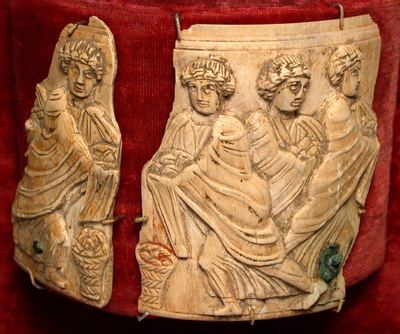
In the pictureTwo ivory fragments lie on red cloth. On the larger one, three figures in draped robes stand side by side with their hands held out, and on the smaller one is a seated figure. Toward the bottom, a basket of loaves can be seen. The ivory has yellowed and is cracked in places.
BackgroundA pyx is a small cylindrical box for keeping the Eucharist (the bread of Communion); in the early Byzantine period these were made of elephant ivory and carved on the outside with biblical scenes. The miracle in which five loaves and two fish fed a crowd is linked to the meaning of the Eucharist, which made it a fitting subject for such a box. Sixth-century ivory carving carries on the drapery folds of late Roman sculpture.
Puzzle tipThe yellowed ivory and the red background are clearly distinct, so outline pieces are easy to find. Fit the outer shapes of the two fragments first, then fill in the faces and drapery folds of the figures by comparing them with the preview. The red background pieces can be told apart only by the weave of the cloth, so put them in last.
- Culture
- Byzantine
- Classification
- Ivories-Elephant
- Medium
- Elephant ivory
- Dimensions
- 7.5 × 12 cm
- Credit line
- Bequest of Nanette B. Kelekian, 2020
Source: The Metropolitan Museum of Art ↗
Stories about this work
- A Thousand Years From One Collector: Five Objects From the Kelekian Bequest
From 6th-century Byzantine ivory to 16th-century Flemish boxwood carving. Crossing a thousand years with five objects one collector left to the museum in 2020.