Saint Barbara
A stone statue of Saint Barbara with long flowing hair, holding a model of a tower; a 16th-century sculpture from the Caen region of France, once painted and gilded. Full commentary ↓
Couldn't load the puzzle image.
Turn on piece outlines to see piece positions on this picture too
Drag the pieces into place · When zoomed in, drag an empty spot to move around
You can also play with a keyboard — Tab to the board, thenSpace pick a piece, Arrow keys move it (with Shift for small steps),Esc deselect, R rotate a piece (Shift+R the other way)
Saint Barbara is a stone object by an unknown maker (16th century) in the collection of The Metropolitan Museum of Art. It measures 141.9 × 59.1 × 43.2 cm.
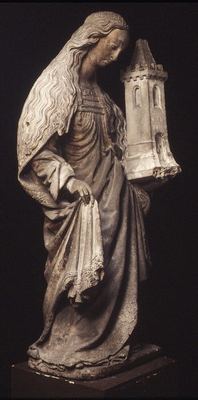
In the pictureAgainst a black background stands a woman carved from white stone. Her long, wavy hair falls below her shoulders; in one hand she holds a small model of a tower, and with the other she lifts the edge of her robe. The folds of her garment are bold and deep, and faint traces of paint remain on the surface. She is 1.4 meters tall.
BackgroundBarbara is a saint who, according to legend, was shut in a tower by her father and later martyred, and the tower is her emblem. As a protector against lightning and sudden death, she became the patron saint of miners and artillerymen. The white limestone of the Caen region is easy to carve and was widely used for church sculpture in northern France; this figure was originally finished with paint and gilding.
Puzzle tipThe white statue stands out sharply against the black background, so lay the outline pieces first. Fit the face, the tower model, and the pieces of falling hair, then join the folds of the robe by the direction of their shadows. The image is tall, so working from top to bottom is easiest. 48 pieces suits it.
- Culture
- French
- Classification
- Sculpture-Stone
- Medium
- Caen stone, originally painted and gilded.
- Dimensions
- 141.9 × 59.1 × 43.2 cm
- Credit line
- Rogers Fund, 1908
Source: The Metropolitan Museum of Art ↗
Stories about this work
- Reading the Lost Color in Four Medieval Sculptures
These sculptures, which now look like white stone or brown wood, were originally brightly painted. What can we read in the places where the color has vanished?