Saint Bernard of Clairvaux
Saint Bernard in a white hooded habit holds a book and leads a black devil on a cord, a panel from Fra Filippo Lippi's workshop paired with A Male Saint. Full commentary ↓
Couldn't load the puzzle image.
Turn on piece outlines to see piece positions on this picture too
Drag the pieces into place · When zoomed in, drag an empty spot to move around
You can also play with a keyboard — Tab to the board, thenSpace pick a piece, Arrow keys move it (with Shift for small steps),Esc deselect, R rotate a piece (Shift+R the other way)
Saint Bernard of Clairvaux is a tempera and gold painting by Workshop of Fra Filippo Lippi (ca. 1447–1469) in the collection of The Metropolitan Museum of Art. It measures 48.3 × 12.7 cm.
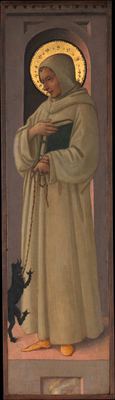
In the pictureA monk with a white hood drawn over his head stands before a gray niche. His cream habit falls to his feet; with his right hand he holds a dark green-black book to his chest, and in his lowered hand he grips a thin cord wound around it. Tied to the end of the cord, a small black horned devil stands on its hind legs and struggles on the ground at lower left. His shoes are orange, and his gold halo is tooled with a ring of dots. At the very top is a sawtooth ornamental band, and at the very bottom a section painted to look like marble. Beneath the hood, his face bows toward the left of the picture.
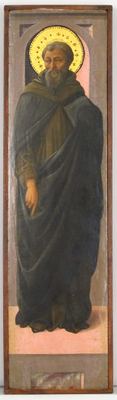
BackgroundBernard of Clairvaux (1090–1153) was the French abbot who led the Cistercian order in the 12th century, and the white habit is the mark of a Cistercian monk. The devil on a cord is an image showing that he overcame temptation and evil. In the museum's records it is paired as A and B with the panel A Male Saint, sharing the same size (48.3×12.7 cm), niche, pink floor and marbled section. It was painted by the workshop of Fra Filippo Lippi around 1447–69. Bernard was renowned for his devotion to the Virgin and for his preaching, and he was painted often throughout the Middle Ages. The Cistercians were a reform order that sought to keep the Benedictine Rule strictly.
Puzzle tipMost of the pieces are white, so fix the places with clear color first. Lay down the face and halo, the green-black book, the black devil at lower left and the orange shoes, then join the spaces between by following the thin cord from the hand to the devil. Fill the white habit by the direction of the fold shadows, and close the frame with the gray wall and the ornamental bands at top and bottom. The devil's black silhouette is distinct and immediately fixes the lower left corner. 24 pieces work well.
- Artist
- Italian, Florence ca. 1406–1469 Spoleto
- Classification
- Paintings
- Medium
- Tempera and gold on wood
- Dimensions
- 48.3 x 12.7 cm
- Credit line
- Robert Lehman Collection, 1975
Source: The Metropolitan Museum of Art ↗
Stories about this work
- Altarpieces Sold Off Panel by Panel: Three Pairs in the Robert Lehman Collection
Large Italian altarpieces were often taken apart and sold panel by panel on the art market. We read the traces of that through three pairs of panels that survive together on this site.
- What "Unknown Artist" Means, How It Is Written in English, and Why 149 Met Works Have No Name
"Unknown artist" means the maker of a work is not known or was never recorded. Here is how the Korean terms jakga misang and jakja misang differ, the English labels (Unknown, Anonymous, Attributed to), and examples from 149 museum works.
Puzzles to try next
More Robert Lehman Collection puzzles· Stories and puzzle tips