What "Unknown Artist" Means, How It Is Written in English, and Why 149 Met Works Have No Name
Published · updated
“Unknown artist” (in Korean, jakga misang) is the label used when who made a work is not known or was never recorded. When these words appear in the artist field of a museum label, the museum is stating plainly that the maker’s name cannot be confirmed. It does not mean information is missing.
Jakga misang and jakja misang
The two Korean terms mean almost the same thing and are used in slightly different places. When the writer of a classical novel or poem is unknown, “jakja misang” (author unknown) is often used; in museum labels for artworks, “jakga misang” (artist unknown) is more common. The line between them is not strict, and many places use them interchangeably. Old sijo anthologies (collections of Korean verse) sometimes grouped their unnamed poets together as “mumyeongssi” (the nameless ones).
How it is written in English
On the labels of museums abroad, “not known” comes in degrees. Catalogues and auction catalogues generally divide it as follows. Definitions differ a little from institution to institution, so for the exact standard it is best to check the glossary of the catalogue in question.
- Unknown, Anonymous: the artist is not known.
- Attributed to X: the work appears to be by X, but this has not been confirmed.
- Workshop of X: made in X’s workshop. It does not assert that X painted it personally.
- Circle of X: the work of a painter active in the same period and setting as X.
- After X: made by someone else based on X’s original.
This site also has two works labeled “Workshop of Fra Filippo Lippi”: Male Saint and Saint Bernard of Clairvaux. That is a different level from not knowing the name, so they are not counted among the 149 works by unknown artists.
149 out of 334
When choosing puzzles, you often come across works whose artist field says only “unknown artist.” Counting them, I found 149 out of 334. That is a little under half.
At first I wondered whether the records were simply incomplete. Looking at them one by one, the situation turned out to be different. Far more of these works never had a reason to carry a name in the first place than had their names lost.
Signing is a later habit than you might think
An artist writing their name on a work is close to the exception across the whole history of art. Even in Europe, painters began signing routinely only after the Renaissance. Before that, people talked first about what a picture was made for, rather than who painted it.
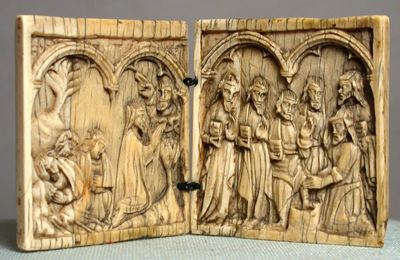 Solve this painting as a puzzle → about 5 minutes on Easy
A 15th-century ivory carving like the Diptych with Scenes from the Passion is a good example. It was an object held in the hands and opened during prayer, not something made to hang on a wall and be admired. What mattered to its user was whether the scenes were accurate and whether it fit well in the hand. Who carved it was beside the point.
Made by a workshop, not a single person
The very way things were made in the medieval and ancient worlds does not fit well with a single name. Most work was organized by workshop. There were separate people to draw the design, carve, paint and gild, so putting one name on the finished piece would actually misrepresent the facts.
As the post on small medieval treasures put it, objects like these were closer to finely made everyday goods than to “works of art.” It is similar to how we do not bother to ask the craftsman’s name when we see a well-made piece of furniture.
In religious painting, erasing the name was a virtue
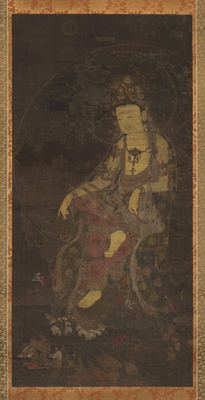
Consider a Goryeo Buddhist painting like Water-moon Avalokiteshvara. It was an object of devotion, far removed from the painter’s self-expression. Not putting oneself forward was considered the proper attitude for its maker. The fact that no painter’s name survives despite how exquisite the gold lines of Goryeo Buddhist paintings are is not because of a lack of skill. There was simply no reason to leave one.
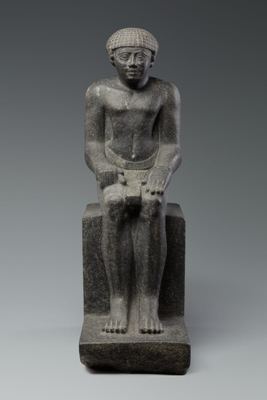
Egypt goes a step further. On a 4,000-year-old statue like The Chief of Police, Mentuhotep, the name of the person depicted is carefully carved, but the name of the maker appears nowhere. The order of which names deserved recording was completely different from ours.
If the artist field is empty, lower the piece count
One practical note as well: works by unknown artists behave a little differently as puzzles.
Paintings by famous artists are usually paintings. They are full of clues for sorting pieces, such as the direction of brushstrokes, the places where color has bled, and the expressions on people’s faces. Works by unknown artists are often photographs of three-dimensional objects such as sculpture, textiles or metalwork. The tones are monotonous and the surface textures look alike, so they feel harder. This is also why Egyptian stone statue puzzles feel especially difficult.
If you choose a work with an empty artist field, it is better to set the piece count one level lower. Even at the same 100 pieces, a Delacroix oil painting and a limestone statue are entirely different games.
What remains instead of a name
The label “unknown artist” is a little different from saying there is no information. It is closer to saying that the kind of information we are curious about was not worth recording in that era. Much else remains instead. We can know which tomb an object came from, what it was used for and what pigments were used.
If you picture where the object originally stood while you solve the puzzle, the empty artist field reads a little differently. The name may be unknown, but the maker’s hand remains in every piece.
Frequently asked questions
What does "unknown artist" mean?
It means that who made the work is not known or was not recorded. When it appears in the artist field of a museum label, the museum is simply stating that the maker's name cannot be confirmed.
Is a work by an unknown artist worth less?
No. The place a work holds in a museum is determined by several factors together, such as when it was made, its condition, its rarity and its provenance. Goryeo Buddhist paintings and Egyptian statues whose makers' names did not survive are examples.
Are the Korean terms jakga misang and jakja misang different?
They mean almost the same thing but are used in different places. When the writer of a classical novel or poem is unknown, "jakja misang" is more common; in museum labels for artworks, "jakga misang" is more common.
How is it written in English?
When the artist is not known, labels say Unknown or Anonymous. "Attributed to X" means the work appears to be by X but this has not been confirmed, "Workshop of X" means it was made in X's workshop, and "After X" means someone else made it based on X's original.
Are works by unknown artists harder as puzzles?
Generally, yes. Many are photographs of three-dimensional objects such as sculpture, textiles and metalwork, so there are fewer clues like brushstrokes or facial expressions. If you choose a work with no artist name, it is better to set the piece count one level lower.