Statuette
A finger-sized wooden figure of a woman with black hair and a patterned skirt, still reaching forward with one arm; painted wood from the 21st century B.C. Full commentary ↓
Couldn't load the puzzle image.
Turn on piece outlines to see piece positions on this picture too
Drag the pieces into place · When zoomed in, drag an empty spot to move around
You can also play with a keyboard — Tab to the board, thenSpace pick a piece, Arrow keys move it (with Shift for small steps),Esc deselect, R rotate a piece (Shift+R the other way)
Statuette is a wooden object by an unknown maker (ca. 2030–1981 B.C.) in the collection of The Metropolitan Museum of Art.
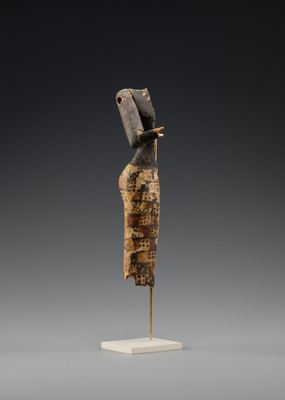
In the pictureA small wooden figure is mounted on a rod. The head is painted black and the face is broken, and on the body a skirt painted with grid and dot patterns in red, yellow, and black survives. One arm reaches forward, and the figure is only 15 cm high.
BackgroundThis little figure was probably part of a tomb model, or a burial offering meant to call on fertility and rebirth. The colorful pattern on the skirt depicts a garment made of strung beads, which links it to the paddle dolls of the same period. With the face broken, its expression cannot be known, but the outstretched arm suggests a pose of holding something or dancing.
Puzzle tipA small figure sits in a dark background, so the outline pieces are everything. Fit the black hair and the patterned skirt pieces first, then set up the vertical axis with the light pieces of the rod and base below. Fill in the rest of the dark background last. 24 pieces is recommended.
- Period
- Middle Kingdom–Early New Kingdom
- Dynasty
- Dynasty 11
- Medium
- Wood, paint
- Dimensions
- H. 14.8 × W. 3.9 × D. 5.3 cm (5 13/16 × 1 9/16 × 2 1/16 in.)
- Credit line
- Rogers Fund, 1926
Source: The Metropolitan Museum of Art ↗
Stories about this work
- Two Dolls from Egyptian Tombs That Look Like Toys but Were Amulets
A flat doll shaped like a paddle and a painted wooden figure the size of a finger. They look like children's toys, but they were amulets of fertility and rebirth placed in tombs.