Statuette of Khnumhotep Receiving Offerings
A palm-sized stone statuette of Khnumhotep seated, wrapped in a cloak with a hand on his chest, whose base inscription asks for offerings. Full commentary ↓
Couldn't load the puzzle image.
Turn on piece outlines to see piece positions on this picture too
Drag the pieces into place · When zoomed in, drag an empty spot to move around
You can also play with a keyboard — Tab to the board, thenSpace pick a piece, Arrow keys move it (with Shift for small steps),Esc deselect, R rotate a piece (Shift+R the other way)
Statuette of Khnumhotep Receiving Offerings is a work by an unknown maker (ca. 1850–1640 B.C.) in the collection of The Metropolitan Museum of Art.
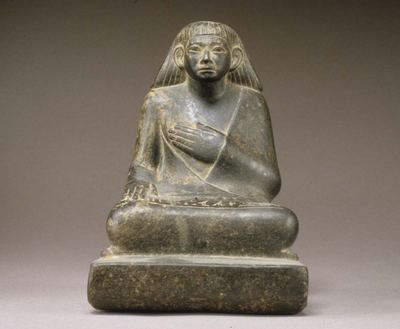
In the pictureA man in a shoulder-length wig sits with his legs together, wrapped in a cloak that covers his whole body. One hand emerges from the cloak to rest on his chest; his face is broad and his eyes are large. Hieroglyphs are carved on the front of the base. It is a small statue, 19 cm high.
BackgroundSeated figures wrapped in cloaks like this were popular in Egypt's Middle Kingdom. Reducing the body to a simple block saved effort in carving the stone while still giving a neat, devout impression. The inscription on the base is a standard offering formula asking that bread and beer, cattle and fowl be given to the deceased Khnumhotep, which tells us the statue was placed in a tomb to receive offerings.
Puzzle tipThe form is simple, so at a lower piece count it comes together quickly. The pieces with the vertical stripes of the wig, the face and the inscription on the base are your clues, and the smooth surfaces of the cloak can be told apart by the brightness of the reflected light. Sort the background pieces into those with the floor shadow and those without.
- Period
- Middle Kingdom
- Dynasty
- late Dynasty 12– Dynasty 13
- Medium
- Diorite
- Dimensions
- h. 19 cm (7 1/2 in); w. 12.4 cm (4 7/8 in)
- Credit line
- H.O. Havemeyer Collection, Bequest of Louisine W. Havemeyer, 1929
Source: The Metropolitan Museum of Art ↗
Stories about this work
- Colorless Egyptian Statue Puzzles: What to Look At Instead
Egyptian sculpture from thousands of years ago has almost no color contrast, which sharply raises the puzzle difficulty. Here is what to look at instead of color.