Colorless Egyptian Statue Puzzles: What to Look At Instead
Published · updated
Most people are thrown when they solve a few European painting puzzles and then move on to Egyptian art. The piece count is the same, but it takes much longer. The reason is simple. There is no color.
You cannot sort by color
Sorting pieces by color is the strategy that works best for paintings, but it loses its power in front of statues carved from limestone or granite. The whole picture is a subtle variation of beige, gray and pale brown, so you cannot tell “this one goes with the sky, that one with the face.”
If you cut the 39 Egyptian art works on this site into a 300-piece grid and measure how much the brightness varies within each cell, at the median more than half the cells (about 57%) are effectively a single brightness. For 50 European paintings, the figure is around 38%. It is a rough measurement close to eyeballing, so it is better to trust the direction than the numbers.
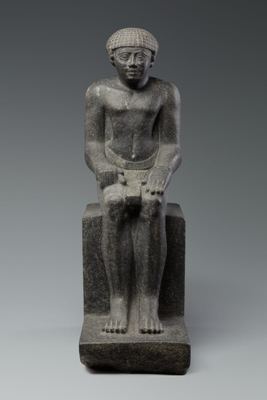 Solve this painting as a puzzle → about 5 minutes on Easy
Open The Chief of Police, Mentuhotep and you will quickly see what this means. The pieces all look almost the same color. Easy is a 4×6, 24-piece grid, and the leftmost and rightmost columns, 12 pieces in total, do not catch a single bit of the statue. Half is background. Even on Normal (6×9, 54 pieces), the top two rows are all background except for the middle two cells.
Line up the background by brightness
Even that background is not a perfectly solid color. The backgrounds of museum photographs are surfaces where studio lighting has spread, so they gradually brighten toward one side. In the Mentuhotep photograph, the top is a dark blue-gray and it keeps getting brighter toward the bottom, until the bottom is well over twice as bright as the top. The top-to-bottom change is much larger than the left-to-right change, so brightness alone tells you roughly which row a background piece belongs to. Lay them out from darkest to lightest and cut them into as many groups as there are rows. For a 6×9 grid, that is nine rows.
Even within the same row, the left side is a little brighter than the right, so a piece or two will be off by a row. Use brightness only to set the rough row, and confirm placement by attaching pieces that touch the statue.
The line where stone meets background
Pieces that the boundary between the statue and the background runs through span two surfaces, so they are not a single color. The slope and curvature of the line become the fingerprint of that position. The line does not break, so the outlines on neighboring pieces must continue at the same height.
The contrast differs at each height. While the background brightens from top to bottom, the brightness of the statue varies from part to part, so for Mentuhotep the stone and background become almost the same brightness at about arm height, while at the height of the legs and base the stone is much darker than the background. Join the easy stretches first: put together the boundary pieces of the legs and base, then work upward. The corners of the base block are vertical and horizontal straight lines, unlike the body, which is full of curves, so you can recognize them at a glance.
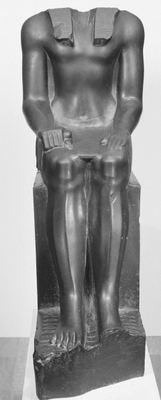
Seated Statue of King Senwosret I is a black-and-white photograph to begin with. The stone has no color, and the photograph has no color information either, so all that is left is how the light spreads. The head is missing, so the top ends at the shoulders, and the highlights running long down the knees and shins are the biggest clue. Why this seated statue always faces forward with left-right symmetry is covered separately in Egyptian sculpture that steps forward with the left foot.
When even the outline blurs, look at the carved lines
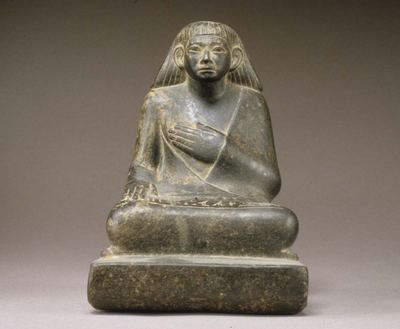
In Statuette of Khnumhotep Receiving Offerings, both the background and the statue are brownish gray, so brightness and hue are almost the same. The boundary is blurry, making it hard to get by on outlines alone. What you can rely on here are the lines carved into the stone: the fine vertical lines of the wig, the ears, the hand laid on the chest, and the small band of inscription running across the knees.
On Easy, the inscription band passes through only about three pieces. There are few of them, but the height of the characters has to match, so they greatly reduce the candidates for neighbors. Areas with distinct texture, such as Mentuhotep’s netlike wig pattern or his toes, serve the same purpose. Zoom in, and the grain of the stone and its worn marks also differ from piece to piece more than you would expect.
Lower the piece count one level
Just because 100 pieces felt comfortable for a painting does not mean an Egyptian sculpture will. As I said in how to choose a difficulty level, how hard a puzzle feels is set by both the piece count and the character of the picture. In statue photographs, around half the cells are close to a single color, so they feel about one level harder at the same piece count. If you solve Normal for paintings, start with Easy; if you solve Hard, start with Normal.
Tall photographs have narrow pieces. For the Seated Statue of Senwosret I, Easy is 3×8, 24 pieces, and Normal is 4×10, 40 pieces. Even if you choose Normal, it is fewer than the stated 48, and it is only three or four cells wide.
You would never look at a stone this long
On screen they look about the same size, but according to the collection records, Mentuhotep is granodiorite 46 cm tall and weighing 22 kg, while Khnumhotep is a statuette 19 cm tall. In a museum, these are objects you would glance at for a few seconds through the glass and walk past. Studying a face that someone carved from stone thousands of years ago, piece by piece and for a long time, is something that rarely happens except in a puzzle.
Frequently asked questions
Why are Egyptian statue puzzles hard?
Because there is no color. If you divide the 39 Egyptian art works on this site into a 300-piece grid, at the median about 57% of the cells are effectively a single brightness.
How do I solve solid background pieces?
In museum photographs, the background gradually brightens toward one side because of the lighting. Use brightness to place pieces in rough rows, then confirm them by attaching pieces that touch the statue.
How many pieces should I start with for Egyptian art puzzles?
I recommend starting one level lower than for paintings. Even if 100 pieces felt comfortable for a painting, a statue takes much longer at the same piece count.