Osiride statue of Senwosret I
A colossal pillar statue of Senwosret I, wrapped like a mummy with arms crossed on the chest: an Osiris figure once set against a pyramid temple pillar. Full commentary ↓
Couldn't load the puzzle image.
Turn on piece outlines to see piece positions on this picture too
Drag the pieces into place · When zoomed in, drag an empty spot to move around
You can also play with a keyboard — Tab to the board, thenSpace pick a piece, Arrow keys move it (with Shift for small steps),Esc deselect, R rotate a piece (Shift+R the other way)
Osiride statue of Senwosret I is a stone object by an unknown maker (ca. 1961–1917 B.C.) in the collection of The Metropolitan Museum of Art. It measures 180.4 cm.
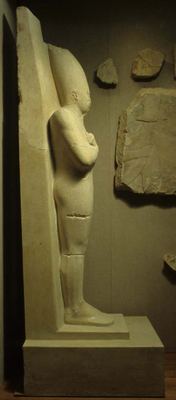
In the pictureA standing figure of the king, carved in white limestone, stands with its back against a pillar. The body is wrapped in cloth like a mummy, the arms are crossed in front of the chest, and the head wears a tall crown. The photograph was taken from the side, so the pillar behind is visible, along with other relief fragments hanging on the wall. It is 1.8 meters tall.
BackgroundThis pose, called an Osiride figure, merges the king with Osiris, the god of death and resurrection. In the pyramid temple of Senwosret I at Lisht, statues like this stood in a row, one at each pillar, showing the king's eternal resurrection, and the Metropolitan Museum of Art's excavation team brought some of them back in the early 20th century. In the temple, they were painted.
Puzzle tipThe picture divides into the white statue, the dark background and the relief fragments on the right wall. Fit the king's face, the crossed arms and the outline of the crown first, then build up the left side with the straight vertical pieces of the white pillar. The relief pieces on the right wall have a different texture and are easy to tell apart. 48 pieces is about right.
- Period
- Middle Kingdom
- Dynasty
- Dynasty 12
- Medium
- Limestone
- Dimensions
- 180.4 cm
- Credit line
- Rogers Fund, 1909
Source: The Metropolitan Museum of Art ↗
Stories about this work
- Why Egyptian Statues Step Forward on the Left Foot: Rules of Pose Kept for 3,000 Years
Why do Egyptian sculptures all look alike? Their poses follow conventions, and once you know them, the puzzle pieces look different too.