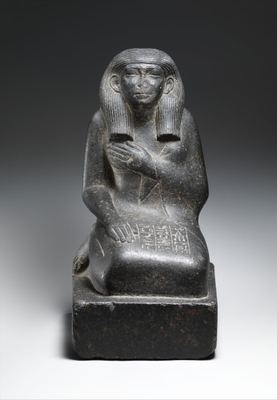
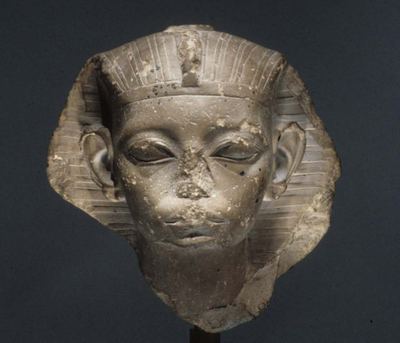
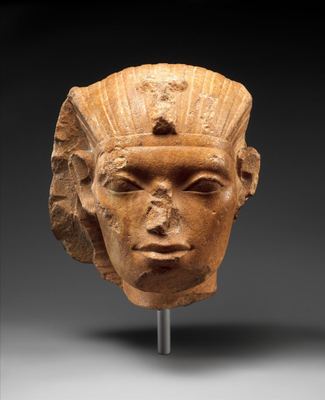
Statuette of Merer
A wooden statue of Merer with vivid red-brown paint and dense inscriptions on kilt and base, at 35.6 cm the largest of four. Full commentary ↓
Couldn't load the puzzle image.
Turn on piece outlines to see piece positions on this picture too
Drag the pieces into place · When zoomed in, drag an empty spot to move around
You can also play with a keyboard — Tab to the board, thenSpace pick a piece, Arrow keys move it (with Shift for small steps),Esc deselect, R rotate a piece (Shift+R the other way)
Statuette of Merer is a wooden object by an unknown maker (ca. 1981–1802 B.C.) in the collection of The Metropolitan Museum of Art. It measures H. 35.6 cm (14 in.).
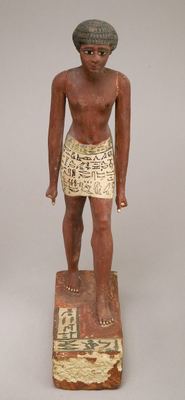
In the pictureAgainst a gray background, a wooden man painted red-brown stands with his left foot stepping far forward. The paint survives so evenly that even his nipples and navel are marked in black; the rows carved into his short curly hair are crisp, and his eyes and eyebrows are painted in black and white. His white wraparound kilt, which has no front panel, is crowded with black and green writing, and his fingernails and toenails are painted white. On the top of the red base, text is written within panels bordered in green, and at the lower front of the base the paint has flaked off, exposing a white ground layer.
BackgroundOf the four statues representing the same Merer, this is the largest (35.6 cm) and has the most evenly preserved paint. The whole kilt and the top of the base carry Merer's name and what appear to be prayers requesting offerings, so the statue itself serves as a small stela. The recorded materials are wood, paint and gesso, and the white layer exposed beneath the base appears to be that gesso ground. Like the other Merer statues, it is thought to date to the 10th–11th Dynasty and to come from Asyut. It is the only one of the four photographed against a gray background, and the wraparound kilt without a front panel is also unique to this statue.
Puzzle tipWith so much writing, positions are actually easy to fix. Assemble the face, the curly hair and the inscribed pieces of the white kilt first, then anchor the bottom with the green-bordered text panels on top of the base and the white chipped spot at the front. On the red-brown arms and legs, the white dots of the nails mark the ends. Fill in the gray background starting with the pieces along the figure's outline. On top of the base the two feet are placed one ahead of the other, so the foot pieces have clear positions. Normal (about 48 pieces) is a good fit.
- Period
- Middle Kingdom
- Dynasty
- Dynasty 10–11
- Medium
- Wood, paint Gesso
- Dimensions
- H. 35.6 cm (14 in.)
- Credit line
- Rogers Fund, 1910
Source: The Metropolitan Museum of Art ↗
Stories about this work
- Four Wooden Statuettes of the Same Man, Merer, Side by Side
Four wooden tomb statuettes from Egypt's Middle Kingdom. They depict the same person, yet the pose, the paint, and even the color of the writing on the kilt differ slightly.