The Assumption of the Virgin
Mary rises to heaven inside an almond-shaped halo borne by angels: the top of an altarpiece Bernardo Daddi painted on a gold ground in 1337. Full commentary ↓
Couldn't load the puzzle image.
Turn on piece outlines to see piece positions on this picture too
Drag the pieces into place · When zoomed in, drag an empty spot to move around
You can also play with a keyboard — Tab to the board, thenSpace pick a piece, Arrow keys move it (with Shift for small steps),Esc deselect, R rotate a piece (Shift+R the other way)
The Assumption of the Virgin is a tempera and gold painting by Bernardo Daddi (1337–38) in the collection of The Metropolitan Museum of Art. It measures 113 × 142.6 × 7 cm.
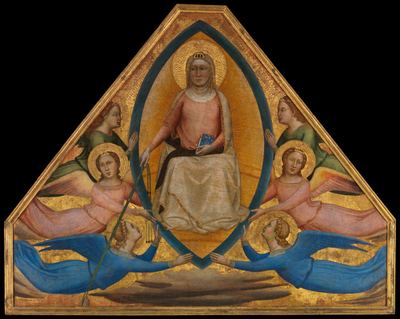
In the pictureIn the center of a triangular panel with a gold ground, Mary sits inside an almond-shaped halo. On both sides, angels in pink and green robes hold on to the halo and push it up toward heaven, while angels in blue below play musical instruments. Mary holds a blue sash in both hands. At the bottom of the picture, the angels' robes flow down over brown rocks.
BackgroundThe Assumption is the story that after her death Mary was taken up into heaven, body and all. The blue sash in her hands is the girdle she is said to have let down to the apostle Thomas as she rose, and this painting is believed to have been part of the altarpiece of Prato Cathedral, which kept that girdle as a relic. The triangular shape shows that the panel sat in the gable at the very top of an altarpiece. Daddi was a Florentine painter who followed Giotto, and he died of the Black Death in 1348.
Puzzle tipThe gold-ground pieces are all one color and hard to tell apart, but pieces from the edge of the halo and the slanting sides of the triangle have clear shapes. Fit the angels' pink, green and blue robes first, then fill in the gold, starting with the pieces that touch the halo and the corners of the panel. Because the triangle narrows toward the top, working down from the peak also works well.
- Artist
- Italian, Florence (?) ca. 1290–1348 Florence
- Classification
- Paintings
- Medium
- Tempera on wood, gold ground
- Dimensions
- 113 × 142.6 × 7 cm
- Credit line
- Robert Lehman Collection, 1975
Source: The Metropolitan Museum of Art ↗
Stories about this work
- A Madonna and Child Pretending to Be 500 Years Old: A Painting Made in an Old Style
One of the Madonna and Child paintings on this site is not a 15th-century work. It was painted much later to look like one, and the museum does not hide that fact.
Puzzles to try next
More Robert Lehman Collection puzzles· Stories and puzzle tips