A Madonna and Child Pretending to Be 500 Years Old: A Painting Made in an Old Style
Published
The Virgin and the Christ Child sit against a gold ground, with saints standing on either side. Scroll down the puzzle list and you meet this kind of picture again and again. It is a format that was painted in large numbers in 14th- and 15th-century Italy.
One of them has an odd production date.
15th century style, made in the late 19th to early 20th century
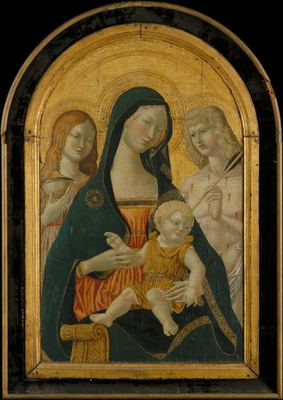 Solve this painting as a puzzle → about 5 minutes on Easy
That is what the information panel for Madonna and Child with Saints Mary Magdalen and Sebastian says. It looks like a 15th-century painting, but the brush actually moved about 400 years later.
When there were not enough originals
In the late 19th century, Europe and America were swept up in a craze for collecting early Italian painting. Gilded altarpieces from Siena and Florence were especially popular, but the number of genuine ones was fixed.
When demand far outstrips supply, someone steps in to fill the gap. Painters appeared who mastered the old techniques and made new paintings “in the style of the period.” Icilio Federico Ioni, recorded as the artist of this work, is known as someone who painted in the old style in Siena.
This is not simple copying. Instead of reproducing a specific original, these painters composed new pictures in the grammar of that era. The whole process was revived the old way: preparing a wooden panel, laying down a gesso ground, applying gold leaf and painting in egg tempera. As a matter of skill alone, it is remarkable.
Why the museum keeps this painting
Even after it was shown not to be genuine, the painting has stayed in the collection, and its information panel states the production period openly.
We can guess at the reasons. The history of authentication is itself evidence. Why a work was once taken as genuine and how it was shown not to be is an important part of art-historical research, and if the physical evidence were discarded, there would be no way to re-examine that process. The painting is also a document of how people in the 19th century imagined the 15th. What collectors of the time felt was “medieval” survives intact on its surface. And the craft of reviving old materials and processes does not vanish just because the work is a fake.
Next to a genuine 14th-century painting
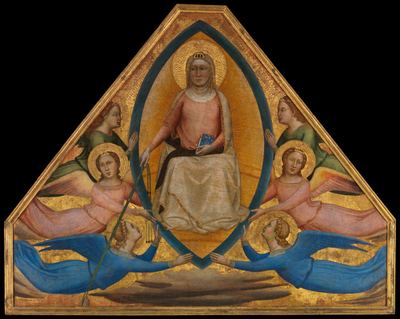
The Assumption of the Virgin is a genuine 14th-century work, painted by Bernardo Daddi in 1337–38.
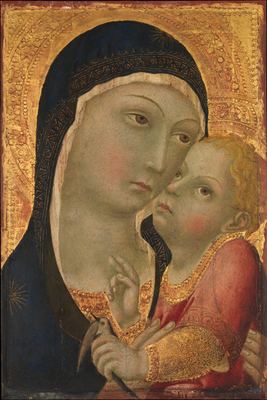
Sano di Pietro’s Madonna and Child dates from about 1450.
Put these two and Ioni’s painting together as puzzles side by side, and the differences slowly start to show at the level of individual pieces.
On old panel paintings, cracks formed as the wood shrank spread across the whole surface like a net. The gold leaf is uneven too, with worn and surviving areas in an irregular pattern. In later works, these traces are sometimes too regular or somehow awkward. Of course, a skilled maker imitates even that, so you cannot judge by eye. Real authentication relies on material analysis and documentary research.
Still, zooming in on each piece one by one is a kind of looking you would never do standing in front of a painting. The details discussed in how to read gold-ground altarpieces come through much more clearly.
Stuck on the gold, freed by the folds
All three works have gold grounds, so the approach to solving them is similar. You get stuck once in the long stretches of gold, and you pick up speed on the figures’ drapery folds and faces.
The composition is also nearly fixed. The Virgin in the center, the Child in her arms, saints on either side. So once you get used to it, a single piece is enough to sense roughly where it belongs. The post on why there are so many Madonna and Child paintings also talked about this format, and if you solve several in a row, the feel for it quickly becomes second nature.
The painting has not changed
The moment you learn it was painted 400 years later, the picture looks different. Not a single thing on the surface has changed, so why?
The paint and the gold leaf are the same. All that has changed is the story we attach to the surface. Perhaps that question is exactly why the museum chooses to put a work like this on view.