Why Early Renaissance Altarpieces Have Gold Backgrounds: Reading the Lehman Panels
Published · updated
The Virgin and Christ Child, saints, angels. The figures vary, but behind them is always gleaming gold. Browse the Robert Lehman Collection and gold backgrounds catch the eye unusually often. Count them, and 22 of the collection’s 39 paintings on wood panel carry “gold ground” in the museum’s medium listing.
Neither sky nor room
In Italian painting before the 15th century, a gold background was a sign that said “this is not a real space.” It meant a holy place outside time and place, neither sky nor the inside of a room. Real gold was beaten thin and applied to the wooden panel, so in a dark church with flickering candles these pictures must have shimmered as if breathing.
As perspective took hold, this convention receded. The moment backgrounds changed from gold to sky and landscape is also the moment the Middle Ages gave way to the Renaissance. That moment came at different times in different cities. Bellini’s Madonna and Child already spread a river, city walls and blue hills behind the figures around 1470, yet even after that, Benvenuto di Giovanni in Siena did not give up the gold ground. Madonna and Child Enthroned from the Marche region was still painted on a gold ground around 1487 (a proposed date).
 Solve this painting as a puzzle → about 5 minutes on Easy
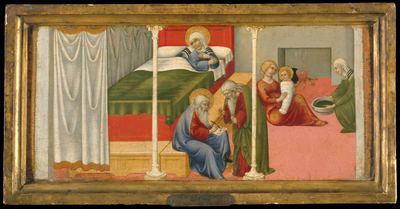
In pictures set indoors, like The Birth and Naming of Saint John the Baptist, the gold gives up the whole background and retreats to halos and gilded borders. The habits of two eras are layered in a single picture.
Gesso, red clay, gold and egg
Gold-ground panels were usually made in this order. A ground of gesso mixed with glue was applied to the wooden panel in several coats, a red clay layer was laid on so the gold would adhere, and then gold leaf was applied and rubbed to a shine. On the gold, tools with pointed tips or carved patterns were used to draw lines and stamp dots, creating the patterns of the halos. The figures and clothing were generally painted after the gold was applied, in tempera, pigment mixed with egg yolk.
This process leaves clues in the puzzle pieces. Gold is thin, so it gets scratched and wears away. The dot patterns appear only around the halos. Ornament built up in gesso is raised and casts shadows. Even if the gold ground looks like a single color, look closely at the pieces and each one shows a different history of what its surface has been through.
Easier than it looks, even if it seems single-colored
Broad areas of gold sound difficult, but in practice they are manageable. To begin with, the contrast between figures and background is extreme. A piece is either gold or figure, so sorting is clean. The gold leaf is often stamped with patterns, so zooming in on the tooled dot and ray patterns around the saints’ halos gives good leads. Most of the picture’s edges also finish in gold, so the border strategy works very well.
Tell gold pieces apart by their traces rather than their color. In Saint Bernardino, the dot pattern of the halo and the scratches in the gold leaf differ from piece to piece, and in The Flagellation, you have to match the stained pieces where the gold leaf has worn away by holding them up against the preview.
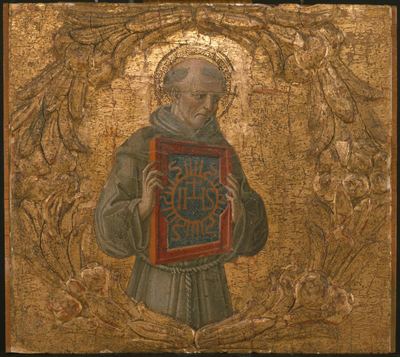
Benvenuto di Giovanni’s Saint Bernardino is surrounded by a fruit garland built up in gesso. The raised pieces carry shadows, so they are easy to separate from the flat gold-leaf pieces.
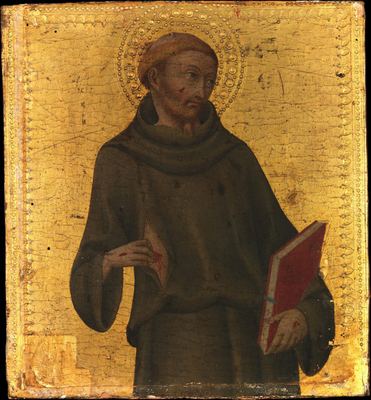
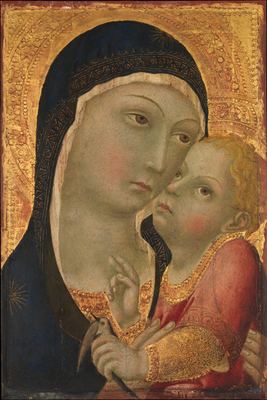
If this is your first time, get a feel for it with a picture where a figure stands large in the center, such as Saint Francis or Madonna and Child. The Madonna and Child divides into four colors: blue cloak, red robe, flesh tones and gold leaf. Fit the two faces first and place the gold pieces with halo patterns toward the top, and the remaining positions narrow down.
Choose the piece count by the number of scenes rather than the size of the panel. For a narrow panel with a single standing saint, 24 or 48 pieces is plenty. A large panel that holds a central scene, saints in compartments on either side and a triangular gable on top in one picture, like Orcagna’s The Crucifixion, is worth trying at up to 300 pieces. The vertical line of the cross and the borders of the side compartments serve as a ready-made skeleton.
Why so many panels are tall and narrow
There is also a reason the pictures in this collection are unusually tall. Of the 39 paintings on wood panel, 29 are taller than they are wide. They are panels that broke away from large altarpieces, or parts of polyptychs made of several joined panels. In an altarpiece with one saint standing in each compartment, the panel narrows to about 18 centimeters wide, and the boards fitted into the pilasters shrink to as little as 12.7 centimeters. They hang separately now, but originally they formed one large structure above a church altar.
Horizontal panels had a different use. Narrative scenes were painted side by side along the lower band of the altarpiece (the predella). That is why The Birth and Naming of Saint John the Baptist has an aspect ratio of almost 2 to 1. You can follow how certain altarpieces were scattered in scattered altarpiece panels.
If a tall, narrow grid appears on the puzzle screen, try imagining which compartment of which altarpiece this panel was originally fitted into. There is plenty of time for thoughts like that while you fill in the gold pieces one by one, and the way puzzles make you look at a picture longer ultimately comes from moments like these.