The Jewish Bride
A man with a golden sleeve tenderly embraces a woman in a red dress: Rembrandt's late painting of a couple, rich in thick paint and warm light. Full commentary ↓
Couldn't load the puzzle image.
Turn on piece outlines to see piece positions on this picture too
Drag the pieces into place · When zoomed in, drag an empty spot to move around
You can also play with a keyboard — Tab to the board, thenSpace pick a piece, Arrow keys move it (with Shift for small steps),Esc deselect, R rotate a piece (Shift+R the other way)
The Jewish Bride is an oil painting by Rembrandt (ca. 1665–69) in the collection of Rijksmuseum. It measures 121.5 × 166.5 cm.
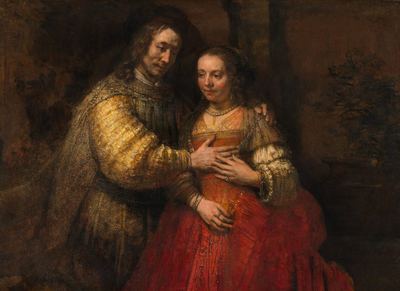
In the pictureA man and a woman stand against a dark background. The man has his left arm around the woman's shoulders and his right hand on her breast, and she gently touches her fingertips to his hand. The man's sleeve is built up with thick gold paint so that it glitters unevenly, and the woman wears a red dress with a pearl necklace and bracelets. The man bows his head to look down at her, and she gazes ahead and downward, as if lost in thought. In the background at the right, a potted tree is faintly visible.
BackgroundIt was painted between 1665 and 1669, in the last few years of Rembrandt's life. It is interpreted as a portrait of a real couple dressed as Isaac and Rebecca from the Old Testament, and the Rijksmuseum also uses that title. The name The Jewish Bride was given in the 19th century by a collector who saw in it a Jewish father placing a necklace on his daughter as she married. Who the models were has not been determined. The man's sleeve is said to have been built up not only with a brush but also with a palette knife. A well-known anecdote tells that Van Gogh could hardly tear himself away from this painting.
Puzzle tipThe man's golden sleeve and the woman's red dress take up much of the lower half, so fit these two masses of color first. The two faces and the hands are bright and easy to find, and the center where the hands overlap is the key that links the two masses. The background mixes a brown wall at the top with a dark greenish-brown tree on the right, so turn on the preview and sort them by differences in brightness. The recommended piece count is about 100.
- Classification
- Painting
- Medium
- Oil on canvas
- Dimensions
- 121.5 × 166.5 cm
- Credit line
- Rijksmuseum, SK-C-216
Source: Rijksmuseum ↗
In these collections: Masterpieces Everyone Knows
Stories about this work
- 16 Must-See Paintings at the Rijksmuseum in Amsterdam
Rembrandt's The Night Watch, Vermeer's The Milkmaid, a Van Gogh self-portrait, plus Hals and Jan Steen. The stories of 16 must-see paintings at the Rijksmuseum, what to check before you go, and how to meet them first as puzzles.