Waistcoat
A 19th-century man's waistcoat of silk woven with small flowers, with gold-thread borders and cord buttons, finished with care down to its patterned lining. Full commentary ↓
Couldn't load the puzzle image.
Turn on piece outlines to see piece positions on this picture too
Drag the pieces into place · When zoomed in, drag an empty spot to move around
You can also play with a keyboard — Tab to the board, thenSpace pick a piece, Arrow keys move it (with Shift for small steps),Esc deselect, R rotate a piece (Shift+R the other way)
Waistcoat is a textile by an unknown maker (19th century) in the collection of The Metropolitan Museum of Art. It measures 54.6 cm.
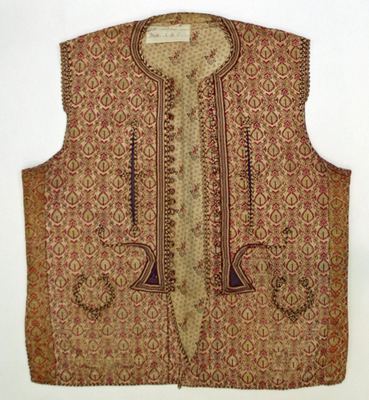
In the pictureA sleeveless waistcoat with an open front is laid out flat. The outer fabric is silk with a small floral pattern mixing red and green, and the front edges, pocket openings and hem have gold-thread borders and cord buttons. A finely patterned lining shows on the inside, and the lower pockets have curved ornament.
BackgroundWaistcoats of silk with woven-in patterns (brocade) were worn widely across the Ottoman Empire, India and Central Asia, worn under a long outer garment so that the pattern showed at the front opening. Using patterned cloth for the lining as well reflects the care taken so that the garment would not be embarrassing even turned inside out. Cord buttons were a long-standing fastening of men's clothing in these regions.
Puzzle tipThe fine pattern repeats over the whole garment, making it hard to place pieces. Make a frame first with the gold-thread borders and cord buttons at the front and the curved pocket pieces, then sort the patterned pieces into lining (light) and outer fabric (red). 48 pieces is recommended.
- Classification
- Main dress-Womenswear
- Medium
- Silk, metal wrapped thread; brocaded
- Dimensions
- 54.6 cm
- Credit line
- Gift of Ethel Frankau, 1950
Source: The Metropolitan Museum of Art ↗
Stories about this work
- From Kurta to Cloak: Six Garments from the Islamic World, Told Apart by Shape
Even within Islamic-world dress, a different shape makes an entirely different garment. Six pieces, from two kurtas to a doll-sized wedding dress, sorted by form.