Wall Bracket
A 14th-century Italian iron wall bracket with a quatrefoil loop, a serpent's head, and a hanging ring. A practical object hammered out by a blacksmith. Full commentary ↓
Couldn't load the puzzle image.
Turn on piece outlines to see piece positions on this picture too
Drag the pieces into place · When zoomed in, drag an empty spot to move around
You can also play with a keyboard — Tab to the board, thenSpace pick a piece, Arrow keys move it (with Shift for small steps),Esc deselect, R rotate a piece (Shift+R the other way)
Wall Bracket is a metal object by an unknown maker (14th century) in the collection of The Metropolitan Museum of Art. It measures 54 × 62.5 × 4 cm.
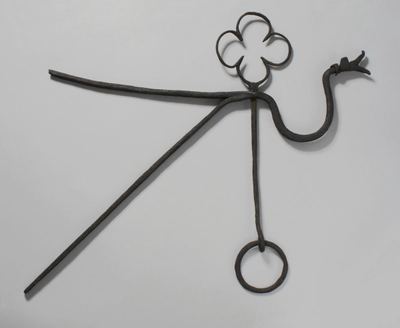
In the pictureBlack iron bars spread like lines across a pale gray background. From a central joint, one bar extends to the left almost horizontally and another runs diagonally down to the left, both tapering at the ends. Above the joint rises a quatrefoil loop, and below, a round ring hangs from the end of a straight bar. To the right, a bar curves upward in an S and ends in a serpent's head with open jaws and a band wrapped around its neck. The surface is uneven, showing traces of hammering, and faint shadows of the bars overlap on the background.
BackgroundThe collection record describes it as a 14th-century Italian iron wall bracket measuring 54×62.5cm, but only 4cm deep, so it is nearly flat. It came in 1908 through the Rogers Fund together with an andiron, also 14th-century Italian ironwork. It was fixed to a wall and used to hang lamps, pots, or clothes, and the quatrefoil is a form taken from the window tracery of Gothic architecture. A single hook would have been enough for hanging things, and the addition of the quatrefoil and serpent's head shows the skill of a blacksmith who did not spare ornament even on a practical object.
Puzzle tipWith only thin black lines and a wide gray background, this is one of the hardest pictures on this site. Place the pieces with distinct shapes first, such as the quatrefoil loop, the serpent's head, and the ring below, then connect the straight pieces of the bars extending in three directions, starting from the central joint. The gray pieces that no bar crosses have to be matched by faint differences in shadow. The bars are thick near the joint and thin toward the ends, so their thickness helps you gauge position. 24 pieces is recommended.
- Culture
- Italian
- Classification
- Metalwork-Iron
- Medium
- Iron
- Dimensions
- 54 x 62.5 x 4 cm
- Credit line
- Rogers Fund, 1908
Source: The Metropolitan Museum of Art ↗
Stories about this work
- From Andirons to Wall Tiles: Five Medieval Objects Without a Single Saint
No saints, no kings. Iron that held up firewood, tiles that covered walls, a marble roundel that decorated a building. Everyday objects and architectural ornament from the Middle Ages that are not religious art.