Wall Tile
A 15th-century Spanish wall tile, 13.5 cm square, where interlacing white bands form stars and compartments of black-brown, amber, green and blue glaze. Full commentary ↓
Couldn't load the puzzle image.
Turn on piece outlines to see piece positions on this picture too
Drag the pieces into place · When zoomed in, drag an empty spot to move around
You can also play with a keyboard — Tab to the board, thenSpace pick a piece, Arrow keys move it (with Shift for small steps),Esc deselect, R rotate a piece (Shift+R the other way)
Wall Tile is a ceramic object by an unknown maker (15th century) in the collection of The Metropolitan Museum of Art. It measures 13.5 × 13.5 × 2.2 cm.
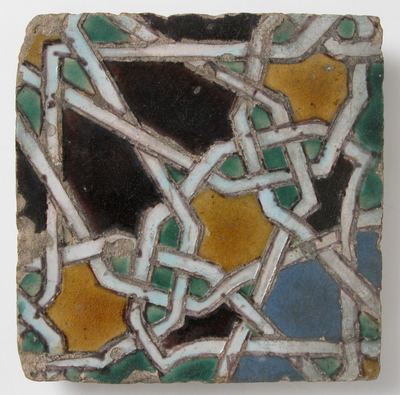
In the pictureOver a square earthenware tile, bands of white glaze pass over and under one another to form stars and polygons. The compartments between the bands are filled with dark black-brown, amber, green and blue glazes: the black-brown covers wide areas at the top and left, amber appears in three places, and the blue compartments are clustered at the lower right. Between the colors remain purplish outlines and narrow unglazed grooves. The pattern is cut off at the edges of the tile and continues beyond them, and the left edge is chipped, exposing the clay. Fine crazing spreads over the surface of the amber compartments.
BackgroundThe Met's records give the place of manufacture as "Seville or Toledo." The geometric pattern of interlacing bands comes from Islamic art, and in 15th-century Spain, Mudéjar workshops covered the walls of palaces and churches with tiles like this. The purplish lines and grooves between the colors appear to be traces of the cuerda seca (dry cord) technique, in which compartments were separated by lines of manganese mixed with grease so that the glazes would not run together. Each tile carries only part of the pattern, so the star design is complete only when many tiles are laid side by side. It measures 13.5 cm square and 2.2 cm thick, and was given by Garrett Chatfield Pier in 1908.
Puzzle tipThe angles at which the white bands turn are the best clue. Place the three amber compartments and the blue compartment at the lower right first, then connect them with white band pieces. The blue compartments are less glossy than the other colors and easy to pick out. In the wide black-brown areas, the spot where the glaze catches the light differs from piece to piece, so use that to tell them apart. Finish the border with the chipped pieces of the left edge. 48 pieces is a good fit.
- Culture
- Spanish
- Classification
- Ceramics-Tiles
- Medium
- Earthenware, glaze
- Dimensions
- 13.5 x 13.5 x 2.2 cm
- Credit line
- Gift of Garrett Chatfield Pier, 1908
Source: The Metropolitan Museum of Art ↗
Stories about this work
- From Andirons to Wall Tiles: Five Medieval Objects Without a Single Saint
No saints, no kings. Iron that held up firewood, tiles that covered walls, a marble roundel that decorated a building. Everyday objects and architectural ornament from the Middle Ages that are not religious art.