The History of the Jigsaw Puzzle, Which Began as a Geography Aid 250 Years Ago
Published · updated
A map of Europe mounted on a wooden board is sawn apart along its borders. As a child fits the scattered countries back together, they learn that Spain lies next to France. This is how the jigsaw puzzle, now enjoyed as a hobby, looked when it first appeared. It was closer to a teaching tool than a toy.
The 1760s: a London mapmaker
The person most often named as the maker of the first jigsaw puzzle is John Spilsbury, an 18th-century London mapmaker. He is said to have learned his trade under the royal geographer. In the 1760s he mounted maps of Europe on thin wooden boards, cut them along the borders and handed them to children. The idea was that as you fit the pieces together, you would naturally memorize which country sits where.
These teaching aids were called “dissected maps” and were used for geography education in upper-class households. Each board had to be cut by hand, so they could hardly have been cheap. They looked like play, but their purpose was clearly learning.
Spilsbury is said to have died in 1769, at around the age of thirty. He did not live to see his idea grow into a toy industry.
The shape of the pieces was different from today, too. Because they were cut along borders, one piece was one country. The France piece was shaped like France and the Spain piece like Spain, so the shape itself was the answer. It differs in its very design from today’s puzzles, which divide every piece into cells of the same size and give them tabs so they lock together.
Where the name “jigsaw” came from
A jigsaw is a thin fretsaw that can cut curves. The name came about because this saw was used to cut wooden boards into winding shapes.
But the tool Spilsbury actually used was not a fretsaw but a marquetry saw. The tool called the jigsaw appeared later. The name was attached long after the puzzle itself. The name “jigsaw puzzle” is said to have become established between the late 19th century, when fretsaws spread widely, and the early 20th century; before that they were simply called dissected pictures or maps.
From wood to cardboard
Until the 19th century, puzzles were made of wood and were expensive. Their subjects widened from maps to educational pictures such as scenes from history or the Bible, but the main customers were still wealthy households with children. Picture puzzles aimed at adults only began to sell in the early 20th century.
Puzzles became a popular hobby once they could be mass-produced from cardboard. Pressing a cutting die into cardboard once cut out an entire puzzle, so the price was beyond comparison with the days of sawing. In the United States in the early 1930s, during the Great Depression, they became wildly popular. They were cheap, they could hold your attention for a long time, and you could put them together again and again. New puzzles are said to have been sold at newsstands every week, and there were even shops that rented out puzzles.
Around the same time, companies also gave puzzles away as promotional items. They were cheap, yet people kept them in hand for a long time, which made them good advertising.
From maps to masterpieces
It was a natural progression for the puzzle, which started out as an educational map, to move on to landscapes and famous paintings. A painting has no fixed borders the way a map does, so it became the maker’s decision how many pieces to divide it into.
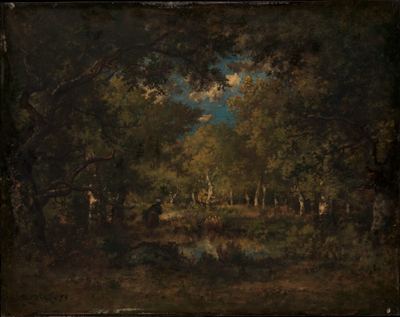 Solve this painting as a puzzle → about 5 minutes on Easy
A painting whose whole surface is filled with detail, like The Forest of Fontainebleau, is easy to divide into pieces. On Easy, the same painting is cut into a grid of 5 across × 4 down, around 20 pieces, and on Expert into 19 × 15, around 285 pieces. Map puzzles produced only as many pieces as there were countries, but now a single difficulty choice changes the piece count. The works’ aspect ratios range anywhere from 0.3 to 3.8, so the grid is laid out differently for each picture. A tall hanging scroll may be divided into 3 across and 7 down.
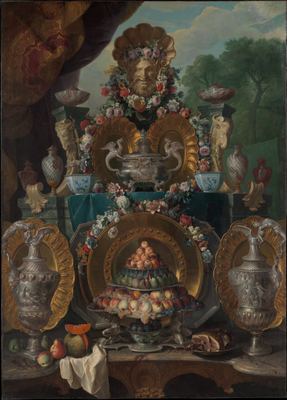
Paintings with clearly defined shapes of objects, like Still Life with Silver, also make good puzzles.
Why the pieces ended up with such winding shapes is covered separately in why puzzle pieces interlock.
Cutting up a masterpiece and putting it back together belongs to the same line as Spilsbury’s maps of 250 years ago. What has changed is what we gain. Back then, children memorized where the countries were; today we gain time spent looking long at a single picture.
Frequently asked questions
Who made the first jigsaw puzzle?
The 18th-century London mapmaker John Spilsbury is generally named. In the 1760s he mounted maps on wooden boards and cut them along national borders to make a geography teaching aid.
Why is it called a "jigsaw"?
A jigsaw is a thin fretsaw for cutting curves, and it was used to cut wooden boards into winding shapes. However, the tool Spilsbury actually used was a marquetry saw; the tool called the jigsaw came later.
When did jigsaw puzzles become a popular hobby?
When they began to be mass-produced from cardboard in the 20th century. Pressing a cutting die into cardboard once cut out an entire puzzle, which made them far cheaper than in the days of sawing wood.