The Forest of Fontainebleau
A dark forest with blue sky breaking through the trees and a lone crouching figure, the densest and deepest of Diaz's Fontainebleau forest scenes. Full commentary ↓
Couldn't load the puzzle image.
Turn on piece outlines to see piece positions on this picture too
Drag the pieces into place · When zoomed in, drag an empty spot to move around
You can also play with a keyboard — Tab to the board, thenSpace pick a piece, Arrow keys move it (with Shift for small steps),Esc deselect, R rotate a piece (Shift+R the other way)
The Forest of Fontainebleau is an oil painting by Narcisse-Virgile Diaz de la Peña (1874) in the collection of The Metropolitan Museum of Art. It measures 47.3 × 60 cm.
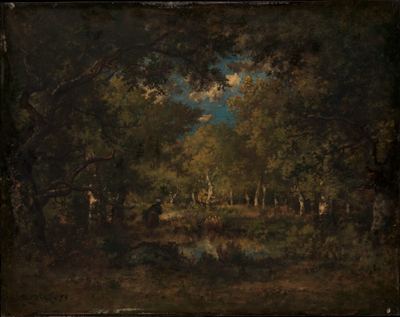
In the pictureThe edges of the picture are nearly black foliage; toward the center, tree trunks and bright sky emerge. There is a pool on the forest floor, and around the middle a small, stooped figure can be seen. Above, patches of blue sky break through the leaves.
BackgroundUntil late in life, Diaz painted the interior of the Forest of Fontainebleau, places where little light gets in. Rather than painting trees against a bright sky, he looks out from inside the dark forest, so the viewer feels as if standing among the trees. Such paintings were especially popular with American collectors at the time, which is also why several works by Diaz entered the Metropolitan Museum of Art.
Puzzle tipThis is one of the hardest puzzles on this site. Pick out the blue sky pieces, the light tree trunk pieces and the figure in the middle first to anchor the center, then work the dark pieces in from the edges. At 300 pieces it takes a long time even with the preview on, so start with a plan to solve it over several sessions.
- Artist
- French, Bordeaux 1808–1876 Menton
- Classification
- Paintings
- Medium
- Oil on wood
- Dimensions
- 47.3 x 60 cm
- Credit line
- Bequest of Collis P. Huntington, 1900
Source: The Metropolitan Museum of Art ↗
Stories about this work
- How to Spread a 300-Piece Puzzle Over Several Days: Resuming and Pausing
A big puzzle can be solved over several days. Progress saves automatically, and you can pause when you step away. An order for multi-day solving and paintings suited to the long haul.
- The History of the Jigsaw Puzzle, Which Began as a Geography Aid 250 Years Ago
The jigsaw puzzle began not as a game but as a geography lesson. Including why it came to be named after a saw.
- 6 Things to Try When a Jigsaw Puzzle Won't Come Together
If you keep picking up and putting down the same pieces, it is time to change your approach. Six methods: switch areas, zoom in, use the preview grid, look at the gaps, spread pieces out, and take a break.