Why a Painting Looks Different Once You Solve It as a Puzzle
Published · updated
People often say that museum visitors spend, on average, only ten-odd seconds in front of a painting. That is not long enough to see the brushwork or the places where color shifts subtly, no matter how famous the painting. A puzzle is different. When you pick up a piece, you have to answer “Where does this go?”, and the answer only comes from reading the painting properly.
Weighing each piece of green sea
 Solve this painting as a puzzle → about 5 minutes on Easy
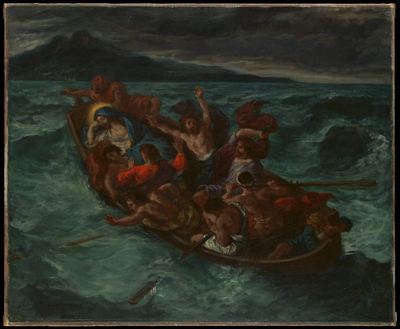
Christ Asleep during the Tempest is one of the Sea of Galilee scenes that Delacroix painted more than six times over during the 1850s. At a glance, you might file it away as “a boat in a storm.” But as a puzzle, more than half the picture is green sea, so you have to weigh every piece. Is it a light piece with foam, or a dark one without? Which way does the brushwork run? Here Delacroix painted the force of the storm instead of its details, and what each piece of sea holds is that force, the trace of a moving brush.
On the boat, the disciples have lost hold of their oars and flail their arms. Only Christ, at the bow, wears red and sleeps with his head on his arm. The red pieces stand out, so they are usually the first you find. Once you have placed them, the composition strikes you anew: in the middle of the uproar, this one person alone is still.
Next to bamboo painted in ink
It is not only European painting. You can also solve paintings from Goryeo and Joseon Korea.
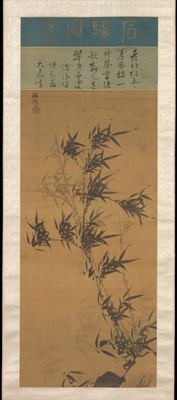
Bamboo in the Wind is bamboo painted in ink by Yi Jeong (1541–1626). Solve a picture that creates depth only through shades of ink right after one that builds up light and shadow in layers of oil paint, and your fingertips learn how differently each culture worked out the problem of making a picture.
Even so, the solving methods overlap. With both Delacroix’s sea and Yi Jeong’s bamboo, you join pieces by following the direction of the brushstrokes. What that direction points to is different. In the waves, it is the direction the water surges; in the bamboo, it is the direction of the wind that sweeps the dark leaves in front and the pale leaves behind to one side. Many pieces show nothing but the silk ground, so raising the piece count too high will actually get you stuck. Sorting pieces by the depth of the ink instead of by color feels strange at first. Then at some point your eye adjusts to it.
Buddhist paintings are different again.
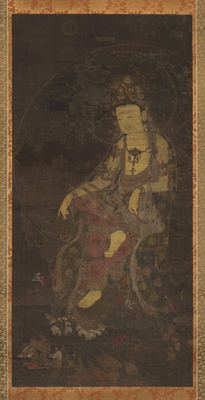
Water-moon Avalokiteshvara is a Goryeo Buddhist painting from the first half of the 14th century. The silk ground is dark, so viewed as a whole the figure is sunk in shadow, and only the red skirt and gold ornaments barely surface. The white lines and gold decoration on the sheer, translucent fabric only become noticeable when you look closely, piece by piece. At the lower left there is a small figure gazing up from the bodhisattva’s feet. This is Sudhana, the boy who sets out on a quest for enlightenment in the Avatamsaka Sutra, and in the darkness he takes up only a few pieces, so he is easy to miss when you look at the whole painting. In a puzzle these pieces gather on their own, and at some point you find yourself asking, “Who is this little person?” How this painting was made is covered separately in The gold lines of Goryeo Buddhist painting.
24 pieces and 300 pieces show you different things
Even with the same painting, your eye goes to different places when you solve it at 24 pieces and at 300. When the pieces are big, you read where the figures are and how the masses of color are laid out; in other words, the composition. When the pieces get small, each holds just a few brushstrokes, so you start to see the speed and direction of the brush. Solve the storm painting once on Easy (about 24 pieces) and once on Expert (about 300), and the same sea looks like two different paintings. For the difficulty that suits each painting, see How to choose a difficulty.
What the pieces don’t tell you
A puzzle makes you look for a long time, but it does not tell you what you are looking at. Which scene in the Gospel of Mark the sleeping figure in the storm comes from, or why bamboo in the wind is linked to a scholar’s integrity, will not emerge however many pieces you fit together. That is why every puzzle page has a commentary below the board: what you see in the picture, its background, and tips for solving, in that order.
Either order works. Read the commentary first and the pieces look like parts of a story you already know; read it after solving and you put names to things your hands noticed first. The preview is off by default. Turn it on only when you are stuck, check the rough position from the dotted outline, and you will stay with the painting much longer.
In the end, appreciating art comes down to how long and how closely you look. A puzzle turns that long looking into play. If the bamboo and the Buddhist painting stayed with you, you can continue with the Korean paintings puzzle guide. Hold on, piece by piece, to a painting you might have passed in ten-odd seconds, and the next time you meet it in a museum, your step may slow down a little.