Why Still-Life Puzzles with Silver and Glass Are So Hard to Solve
Published
An apple is red wherever you cut it. Pick up a piece and you know right away, “Ah, it’s the apple.” That is why still lifes are generally good for puzzles. Each object has clear boundaries, the colors are varied, and the picture is just complex enough. Leaves do not repeat endlessly the way they do in a landscape.
Yet among still lifes there are some paintings you just can’t make headway on. They are the ones with silver bowls, glasses or brass jars.
A silver bowl has no color of its own
The color of a silver pitcher is less silver than the color of the things around it. Where the red cloth beside it is reflected, that part is red; where a window is reflected, it is light gray; and the shaded side is almost black. It is the same object, but its color is completely different from piece to piece.
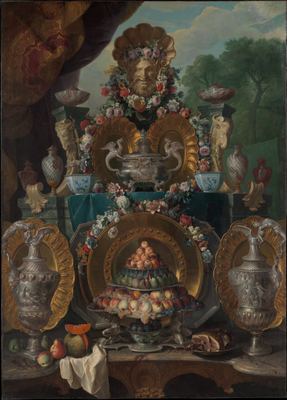 Solve this painting as a puzzle → about 5 minutes on Easy
Zoom in on Still Life with Silver and it is obvious. A single bowl contains white, gray, brown and black. This is why the strategy of sorting pieces by color does not work well here. Sort by color, and the pieces of one pitcher scatter into several piles.
Light and shadow split within a hand’s width
On a reflective surface, brightness changes drastically over a short distance. Right next to the brightest highlight sits a shadow.
In a puzzle this cuts both ways. Pieces with a highlight stand out and are easy to find. The midtone pieces around them are almost impossible to tell apart. So you place a few pieces in an instant and then get stuck on the rest for a long time.
Follow line and light instead of color
On reflective surfaces it is better to sort by whether an outline passes through a piece than by color. First gather the pieces that contain distinct lines, such as the rim of a bowl, the curve of a handle or the edge of a plate. A line has to continue without breaking, so the candidates for its neighbors narrow sharply.
Use highlights as reference points. There are only a few brightest points in the picture. Put these in place first and the rough position of each object is set, and from then on you can narrow your thinking to something like “the lower left of this pitcher.”
Another tip is to finish one vessel at a time rather than looking at the whole. Reflective surfaces hold the colors of neighboring objects, so the wider you look, the more confusing it gets. Complete one, and the candidates for the pieces around it narrow on their own.
And always zoom in. On a zoomed-out screen, a reflective surface is just a gray mass. Only when you zoom in can you see the direction of the brushstrokes and the subtle tones. Few genres vary this much in difficulty depending on whether you zoom in or not.
The ink still life: the problem is empty space
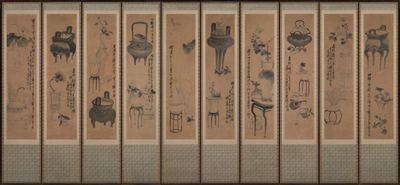
Even as a still life, Jang Seung-eop’s Still life with bronze vessels and flowering plants is a different case. It places bronze vessels together with flowers, but rather than painting the reflection of light in fine detail as Western oil painting does, it builds forms with ink lines and empty space.
So the kind of difficulty changes too. There is less confusion from reflections, but the empty space of the silk ground takes up a considerable part of the picture, which brings the problems of paintings with large empty areas. Join the pieces that ink lines pass through first to build a framework, and fill in the empty space last.
Purple inside a silver pitcher
Once you have finished a reflective-surface puzzle, the way you look at paintings changes a little. Piece by piece, you see how many colors the painter used to paint a single silver vessel.
From a distance it is just a shining silver pitcher, but divided into pieces, even purple and green turn out to be hidden inside it. If it were not for the puzzle, it is a spot you would have looked at for a few dozen seconds and passed by.