How to Solve Puzzles with Large Plain Areas Like Sky or Walls
Published · updated
The figures are done, and so are the objects. But the parts with nothing in them, like the sky or a wall, are left as a pile of pieces. Every time you do a puzzle, your hands stop at this point.
Plain areas come later
Let’s make this clear first. Plain areas are best done last. Once the surroundings are filled in, you can work backward from the shape and position of the remaining spaces, so you can place the pieces even if you cannot tell them apart. Tackle a plain area from the start, and all you do is keep trying pieces at random with no clues.
That is also why the order for sorting pieces says to keep a separate pile of “ambiguous leftovers.” It is good to count how big that pile will be before you start.
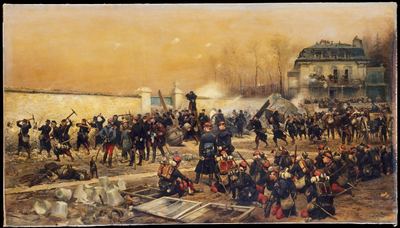 Solve this painting as a puzzle → about 5 minutes on Easy
The Defense of Champigny is packed with soldiers and objects at the bottom, and the top is a yellowish sky. It is a wide picture, so opened on Expert it is 23×13, or 299 pieces. Turn on the preview and count the spaces taken by the sky, and you get a little over 60 pieces across the top four rows, a fifth of the whole. When a section you vaguely thought of as “a lot of sky” becomes “the last 60 pieces,” you can gauge how much work is left.
They look plain, but they all differ
Even surfaces that look like a single color are rarely completely even. Zoom in and there are usually differences in three places.
First, the sky or a wall gets lighter or darker toward one side.
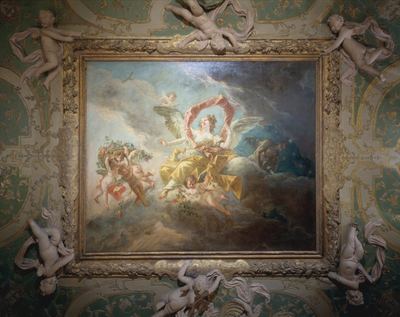
The sky in Dawn is light on the left and dark on the right. It depicts the moment night recedes, so the change is clear. Lay out the sky pieces from lightest to darkest and you get their rough horizontal position. Which way the light increases differs from painting to painting; it can be top to bottom or left to right. Before touching the pieces, check the direction in the preview.
Brushwork is also a clue.
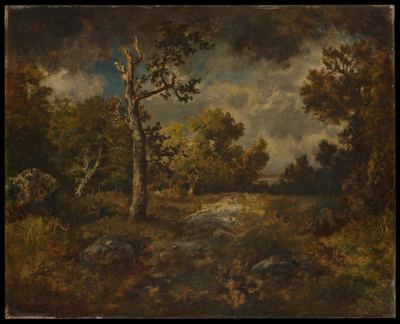
The Edge of the Woods is painted with thick paint on a wooden panel, so the grain of the brush remains even in the storm clouds and the dense masses of leaves. Even if they are the same dark green and brown, a piece whose grain lies horizontally and a piece whose grain curves diagonally belong in different places. A forest that looks like a single green also splits into yellowish and bluish tones from part to part. The story of Diaz, who painted this picture, is in two paintings where Diaz left the forest.
In dark paintings, look at the lines that divide the surfaces rather than the surfaces themselves.
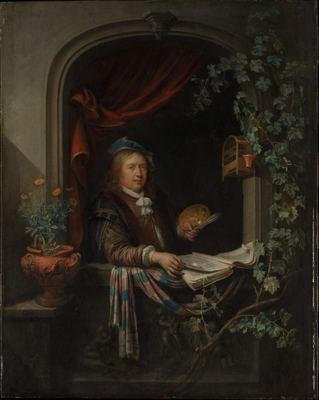
Open Self-Portrait on Normal (6×8, 48 pieces), and about twelve spaces, counting the darkness inside the arch and the bottom row, are nearly black. Pieces like these cannot be found by color. Just picking out the pieces that the rounded edge of the arch or the horizontal line of the windowsill pass through fixes their place within the black area.
Zoom in to look, then try them on the board
These differences are almost invisible on a zoomed-out screen. The + button enlarges 1.2 times per press, up to 3 times, so about four presses doubles the size. While zoomed in, drag an empty spot to move the view, and compare by going back and forth between the pile of pieces and the place they should go. To return to the original zoom, press the Reset zoom button.
Even so, some pieces remain that you cannot tell apart by eye. Then trying them directly costs less than staring for a long time. On this site’s puzzles, only pieces that are actually neighbors in the finished picture snap together. Bring three or four similar-looking candidates one at a time next to the empty space, and only the right piece will stick; a wrong piece will not snap even if its shape seems to fit. The piece’s border turning orange near its spot is also a clue. It signals that the piece has come within about a third of a piece’s side of its correct place.
For sky gathered on one side, close the boundary first
If a plain area extends to the edge of the picture, the border strategy works well. Pick out the pieces with a flat side first, and even in a plain area the position narrows to something like “this is the top edge.”
When an entire section is a single color, as with the sky in Champigny, don’t start from the inside. The top row is sky across the full width of the picture, but the lower you go, the shorter the rows get, cut off by the mansion and trees on the right. The pieces inside the sky look nearly identical, but the line where the sky ends catches the top of a wall, tree branches and a roof, so those pieces are not plain. Join these boundary pieces first, and it is settled how far the sky reaches and how many pieces fit in each row. The inside comes after that. Line them up by brightness, from the deep amber at the top to the paler color above the wall, and within the same row, sort left and right by matching tabs to slots.
When only the sky is left
The most tedious moment is when all that remains is sky. The tip to move to another section if you make no progress for more than three minutes is discussed in 6 things to try when a puzzle won’t come together. The one that applies only to plain sections is the hint button. A hint places in its spot the one piece, among those not yet in place, that sits farthest to the upper left in the finished picture. In a painting where the sky is gathered at the top, the piece the hint brings out becomes the first piece of sky, and you can start again from the spaces to its right and below it.
Even an empty sky is ultimately determined by its surroundings. The spot where the last piece goes becomes visible not when you stare at that piece, but when everything else is filled in.
Frequently asked questions
When should I do plain areas like sky or walls?
Doing them last is the right call. Once the surroundings are filled in, you can work backward from the shape and position of the remaining spaces, so you can place the pieces even if you cannot tell them apart.
How do I tell apart pieces that look like a single plain color?
Zoom in and look at three things: changes in brightness that lighten or darken toward one side, the grain left by the brush, and, in dark paintings, the lines that divide the surfaces. The + button zooms in 1.2 times per press, up to 3 times.
What do I do with pieces I can't tell apart by eye?
Try them directly on the board. On this site, only pieces that are actually neighbors in the finished picture snap together, so if you try three or four similar candidates one after another, only the right one will snap.