Why "Just One More Piece" Turns into 30 Minutes
Published
“I’ll just fit this piece and go to bed.” Then you look up and 30 minutes have passed. Anyone who has done a puzzle has probably experienced this at least once.
It is not because your willpower is weak. A jigsaw puzzle has almost every condition that makes it hard for people to stop. Once you know how the structure works, this absorption becomes much easier to handle.
1. Unfinished tasks stay in your head
Psychology has a term called the Zeigarnik effect. It says that unfinished tasks stay in memory longer than finished ones. Finished tasks get filed away and disappear from your mind, while unfinished ones keep coming back.
Puzzles create this state endlessly. Fit a piece and you notice the empty spot next to it. Every time you finish one thing, a new unfinished thing appears. The feeling of having done it and the feeling that there is still more come at the same time.
2. “That’s right” comes every few seconds
In a puzzle, a piece clicks into place every few seconds to few dozen seconds. That is a fairly short interval, and whether it is a success or a failure is decided on the spot.
It snaps, or it doesn’t. There is no room to wonder whether you are doing well, so you keep going.
3. The difficulty drops on its own
There is a condition that often comes up in talk about flow. Too easy is boring and too hard is stressful, so people say flow happens somewhere in between.
Puzzles strike that balance on their own. At first there are many pieces and it is hard, but you can start with easy parts like the border. As you progress, the remaining pieces decrease and the candidates narrow. The difficulty, in effect, lowers itself as you go. The difficulty curve that game designers work hard to build is in a puzzle from the start.
4. The voice in your head goes quiet
While you do a puzzle, very few words run through your head. Matching colors and shapes requires no language.
Worry and brooding usually arrive in the form of words (“What am I going to do about that thing tomorrow?”). When the part of the mind that uses language is occupied with something else, there is less room for that voice to cut in. That is why your head feels refreshed after doing a puzzle.
Putting absorption on your side
This structure can be used for bad or for good.
If you want to build a habit, use it to lower the threshold for starting. It is good to start small, at 24 pieces. As I said in how to make puzzles a habit, if “one puzzle = 10 minutes,” doing it every day is easy.
If you want to keep to a time limit, decide in advance where you will stop. Stopping by section, as in “I’ll finish just this area and stop,” is easier to stick to than stopping by minutes. What is hard is stopping in an unfinished state, so make one small completion and then get up.
When you step away, pressing pause stops the clock. Progress is saved automatically, so you can simply close the window, and next time you come back it continues as it was.
When you’re stuck, the same structure trips you up
Sometimes the same structure runs in reverse. If you have not fit a single piece for 20 minutes, the “that’s right” signal stops and only the feeling of something unfinished remains. Hanging on at this point is a loss. As covered in what to do when a puzzle won’t come together, it is better to move to another section or take a short break.
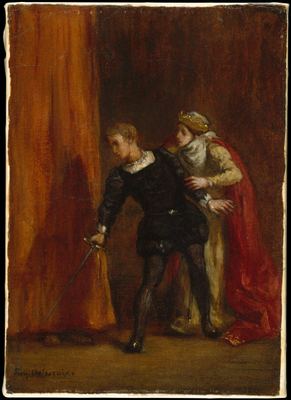 Solve this painting as a puzzle → about 5 minutes on Easy

In paintings with large dark areas, like Hamlet and His Mother or The Natchez, a long stretch like this comes in the middle. Knowing it in advance makes it less tiring.
Well-designed boredom
The fact that puzzles have survived so long is probably because this structure suits people well. Few pastimes have stayed almost unchanged in form for more than 200 years.
So there is no need to blame yourself for letting 30 minutes slip by. That is simply how the pastime is made. Knowing this, you feel a little less cheated.
Frequently asked questions
Why does "just one more piece" turn into 30 minutes?
Each time you fit a piece, you see the empty spot next to it, so every completion creates a new unfinished task (the Zeigarnik effect), and the signal "that's right" comes without ambiguity every few seconds to few dozen seconds. It is not a matter of willpower but of structure.
Why does doing a puzzle make my head feel clearer?
Matching colors and shapes is nonverbal work, so very few words run through your head. Worry and rumination usually come in the form of words, and when the language circuits are occupied with something else, there is less room for that voice to cut in.