How to Make a Masterpiece Puzzle a Day a Habit
Published · updated
“Ten this week.” A goal like that usually falls apart around Wednesday. Skip one day and the goal is broken, and a broken goal becomes an excuse to quit. Whether someone keeps a hobby going for years or drops it in a few days depends less on willpower than on how they set their rules at the start. Puzzles are no different.
Make the rule “open it once a day”
Lower the bar drastically. All you have to do is open a puzzle page once a day. You don’t have to finish it. Move a few pieces and close it, and today’s share is done. Your progress is saved, so you can pick up where you left off next time.
That much you can keep every day, and what you keep every day becomes a habit. Besides, once you open it, there are many days when you end up staying with it longer than you expected.
One distinction is worth making. The “open it” rule is kept even if you don’t finish, but the Today’s Puzzle streak described below only grows when you complete that day’s puzzle all the way. It lasts longer if you keep opening the page as your baseline rule and treat finishing one on Easy on days you have time as a bonus.
On tired days, 24 pieces
Repeating the same difficulty over and over gets either boring or overwhelming. Just match it to how you feel that day.
- Days when you’re short on time or tired: Easy (about 24 pieces). It’s done in five minutes.
- Relaxed weekends: settle in with one on Hard or above.
As mentioned in how to choose a difficulty, you can change the number of pieces at any time.
The same work becomes a completely different puzzle depending on the difficulty. The tall, narrow Diana is 4×7, or 28 pieces, on Easy, and 8×13, or 104 pieces, on Hard. Today’s Puzzle counts as completed for the day at any difficulty, so even if you finish it on Easy on a busy day, your streak continues.
For example: on weekdays, one Today’s Puzzle on Easy. On Saturday, one on Hard. On Sunday, solve again a painting you liked during the week at the same difficulty and compare your times.
This month, European paintings only
Picking within one category feels more rewarding than wandering at random through more than 300 works.
Do only European paintings this month and only Korean paintings next month, for instance. When you look at paintings of the same kind one after another, things you only see side by side start to appear. You begin to notice how each painter’s brushwork differs, and how color varies by region even within the same period.
You can also gauge the amount. European paintings has 50 works and Korean paintings has 18, so at one a day you go through each once in 50 days and 18 days. On days when even choosing feels like too much, Today’s Puzzle picks for you. It mixes categories evenly, so you meet works you never expected. At the bottom of each category page are posts about that group, which make good reading when choosing this month’s theme.
Keep the paintings you like in a bookmark folder
As you solve, some works stay with you more than others.
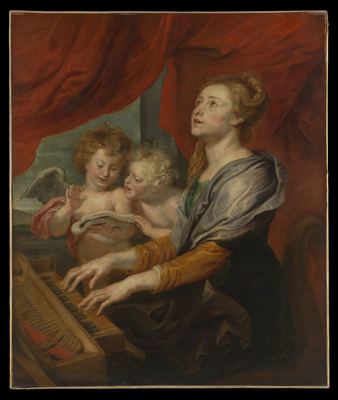 Solve this painting as a puzzle → about 5 minutes on Easy
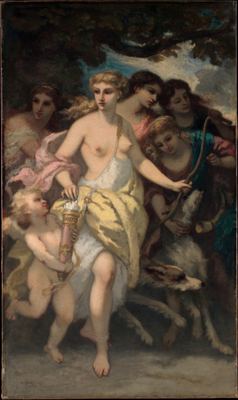
Paintings like Saint Cecilia or Diana, with lovely color or a lasting impression.
There is no sign-up, so the site has no favorites feature. Instead, make a folder in your browser bookmarks and it becomes your own collection. When you solve them again later, they go much faster than the first time, and feeling that difference is part of the fun.
Competing with your past self
When you complete a puzzle, the results page shows how long it took. Solving the same work again at the same difficulty and comparing times keeps drawing you back. You’re not competing with anyone else, only comparing with your previous self, so there’s no pressure.
The comparison is tracked separately for each combination of work and difficulty. If you beat your record, the results page shows how many minutes and seconds faster you were; otherwise it shows which completion this is.
If you want to build up a record by date, use the Today’s Puzzle page. The work changes at midnight Korea time, everyone who opens it gets the same painting, and no matter how many times you solve it in a day, only your first time of the day is kept. If you haven’t solved today’s yet, the streak counts the days up to yesterday. So you won’t be annoyed to see 0 days when you open it in the morning. If you skip an entire day, the number starts over from 0, but the total number of Today’s Puzzles you have completed, shown separately beside it, stays as it is. On days you solve it, the page also shows a “Completed today” mark.
Two things to know. It is recorded as that day’s completion only if you go in through the button on the Today’s Puzzle page. If you open the same work’s address directly and solve it, it is kept only as a regular completion. And all records are saved in this browser, not on a server, so if you change devices or clear site data, your streak starts over too.
Works are drawn so that the same painting doesn’t come up twice until the whole list has been used once. With the current number of works, that takes close to 300 days. There’s no prize or badge for going all the way around. What remains are the days you met the paintings one by one, and a streak counted in numbers. I think that’s enough.