6 Things to Try When a Jigsaw Puzzle Won't Come Together
Published · updated
There are about 30 pieces left, and you haven’t fit a single one in 20 minutes. You have picked up and put down the same piece several times now. Every puzzle has a stretch like this. Gritting your teeth and concentrating harder won’t help much at that point. You need to change your method.
First, see where you’re stuck
Before choosing a method, take a look over the remaining pieces. If they are almost all a similar color, you are stuck because there are no clues. In that case, as in Strategies for large solid areas, the right move is to wait for the surroundings to fill in, and methods 1 and 4 below work well. If each piece has visible clues but still won’t fit, you are not reading the clues properly, so use methods 2, 3, and 5. If you keep picking up and putting down the same pieces, your eyes are tired, so go with method 6.
Move somewhere else
- Switch areas. This is the most effective method and the one everyone uses least. Simply leave the part you have been stuck on and move to another side. The “three-minute rule” from Habits that cut your completion time is the same idea. If you can’t decide where to go, head for an edge where several neighbors are already joined. In this puzzle, pieces only snap to their actual neighbors, so a section never grows in the wrong shape, and the conditions for where a new piece can go increase accordingly.
Change how you look
- Zoom in. Seen small, the pieces all look about the same. Enlarge them with the
+button and the direction of brushstrokes, subtle differences in tone, and surface texture appear. You can zoom up to 3x. While zoomed in, drag an empty area to move the view, and press the “Reset zoom” button to return to the starting zoom in one step.
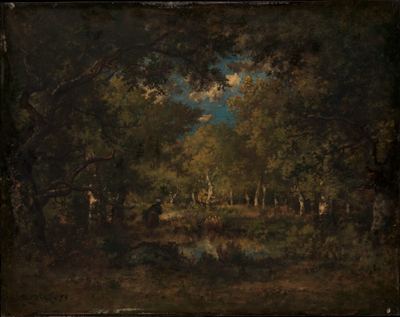 Solve this painting as a puzzle → about 5 minutes on Easy
For a painting like The Forest of Fontainebleau, where foliage covers the whole picture, the difficulty is completely different depending on whether you zoom in or not.
-
Use the preview grid. When you turn on the preview, a dotted grid of pieces appears over the finished picture. Compare the color combination of the piece in your hand with the cells and see which one it resembles, and the candidates drop sharply. When one axis has more than 9 cells, lines are not drawn for every cell, so at Hard and above, read it in zones of two or three cells grouped together.
-
Look at the gaps, not the pieces. Usually you think, “Where does this piece go?” Try the reverse. Pick one gap and look for the piece that goes there. A gap’s surrounding pieces already give you clues (sky blue above, a branch to the left), so the conditions are much more specific. Among the gaps, pick the ones with neighbors on three sides first. They have far fewer candidates than a spot with only one side filled.
Tidy the board and take a short break
-
Spread the pieces out again. When pieces are stacked in layers, you can’t see the ones underneath. Even if they start out not overlapping, they inevitably pile up as you make heaps while sorting. Just spreading a pile out into an empty area of the screen makes pieces you hadn’t noticed jump out. This alone solves things more often than you’d think.
-
Take a short break. It sounds obvious, but it really works. When you keep looking at the same pieces, your eyes get used to their patterns and stop noticing differences. Do something else for just five minutes and come back, and they will look as if you are seeing them for the first time. Progress is saved automatically, so you can simply close the window. When you reopen it in the same browser, the positions of the pieces and the elapsed time carry on as they were. The pause button stops the clock but also hides the picture, so you can’t use it to study the picture while you rest.
If that still doesn’t work
The hint button places one piece in its correct spot. Which piece it will be is fixed: among the pieces not yet in place, it starts with the one closest to the top left of the finished picture. So if the spot you are stuck on is not near the top, treat the piece the hint places as one more clue rather than the answer. A game in which you used hints still records your completion time the same way.
Holding pieces up to the board is another way to check. A correct neighbor snaps the moment you place it close, and a wrong piece won’t snap even if its shape seems to fit. The snapping tolerance is about 20% of the piece size, so just bringing it roughly alongside is enough. If there are two candidates and you can’t tell which, just try both.
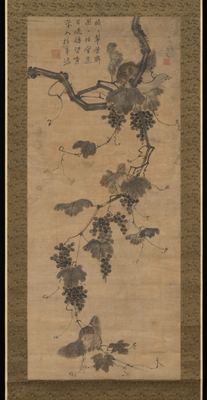
Lowering the difficulty is also an option. Paintings done in gradations of ink, like Grapevine and Squirrels, or works with large solid areas feel much harder even at the same piece count. Progress is saved separately for each difficulty, so if you get stuck at Hard and drop down to Easy, your Hard progress stays as it is. However, “Reshuffle” erases your progress at the current difficulty, so be careful not to press it in a moment of frustration.
If you are stuck to the point where the fun is gone, it’s fine to go down one level, get to know the picture, and then come back up. Sitting there until the very end is not the only right answer. The pleasure of a piece you couldn’t see for ages jumping out at your rested eyes all at once is one of the joys a puzzle gives you.
Frequently asked questions
What should I do first when I'm stuck on a puzzle?
Leave the area you are stuck on and move to another part of the board. It is the most effective method and the one people use least; later, once the surroundings are filled in, the shape of the gap will tell you the answer.
Which piece does the hint button place?
Among the pieces not yet in place, it places one, starting with the one closest to the top left of the finished picture. So if you are stuck near the bottom, the piece for the spot you want may not come up right away.
If I hold a piece up to the board and it doesn't snap, is it wrong?
Yes. A correct neighbor snaps the moment you place it close, and a wrong piece will not snap even if its shape seems to fit. The snapping tolerance is about 20% of the piece size.