A Royal Woman
A gabbro bust of a woman in a long wig with a cobra on her brow, from Dynasty 12 of the Middle Kingdom, reign of Amenemhat II–Senwosret II. Full commentary ↓
Couldn't load the puzzle image.
Turn on piece outlines to see piece positions on this picture too
Drag the pieces into place · When zoomed in, drag an empty spot to move around
You can also play with a keyboard — Tab to the board, thenSpace pick a piece, Arrow keys move it (with Shift for small steps),Esc deselect, R rotate a piece (Shift+R the other way)
A Royal Woman is a work by an unknown maker (ca. 1919–1878 B.C.) in the collection of The Metropolitan Museum of Art. It measures H. 20.3 cm (8 in.).
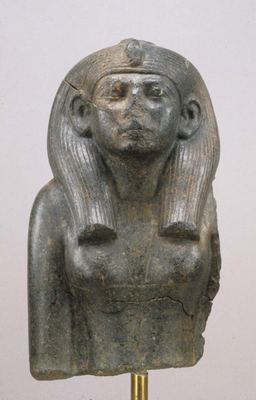
In the pictureThe upper body of a woman, carved in dark gray-black stone, stands on a gold-colored support rod. A long wig incised with fine, closely spaced vertical lines leaves the ears exposed and falls in front of both shoulders, ending bluntly over the chest, and a worn cobra rises at the center of the forehead. A crack runs from the left temple across the nose to the cheek, another runs horizontally below the chest, and everything below the waist and along the right edge of the image has broken away. It is 20.3cm high. The face is broad with prominent ears, and the breasts are rounded and full.
BackgroundThe cobra on the brow (the uraeus) was a mark worn only by kings and royalty, so even though her name has not survived, it tells us this woman was a queen or a princess. The museum's record dates the statue to Dynasty 12 of the Middle Kingdom, in the reigns of Amenemhat II to Senwosret II (about 1919–1878 B.C.). Gabbro is a very hard, dark igneous rock, and polishing it this smooth is not easy. It entered the collection in 1908 through the Rogers Fund. No inscribed name survives and the find spot is recorded only as "Egypt," so where the statue originally stood is unknown.
Puzzle tipThe crack across the face and the cobra on the brow are the best reference points. Assemble the face first, then sort the wig pieces into left and right by the direction of the vertical lines and where the ends turn blunt. Run the pale gray-violet background around the pieces that touch the outline of the bust, and use the gold rod pieces at the bottom to set the center line. The horizontal crack below the chest marks the height of the torso pieces, and the rounded outline at the top of the head stands out clearly against the background. 48 pieces is a good fit.
- Period
- Middle Kingdom
- Dynasty
- Dynasty 12
- Medium
- Gabbro
- Dimensions
- H. 20.3 cm (8 in.)
- Credit line
- Rogers Fund, 1908
Source: The Metropolitan Museum of Art ↗
Stories about this work
- Four Egyptian 12th Dynasty Royal Sculptures Recognizable as Royalty Without a Name
Even when the name is lost, a headdress worn in place of a crown and a cobra on the brow reveal royalty. Four sculptures of nameless kings and queens.