Four Egyptian 12th Dynasty Royal Sculptures Recognizable as Royalty Without a Name
Published
Imagine a face carved in stone. The tip of the nose is broken, and no trace remains of the name that would have been carved on the base. Yet if a cobra rears its head above the brow, the story changes. The Egyptian Art category holds several sculptures that have lost their names, and four of them reveal, without any name, that they were kings or queens, thanks to marks only royalty could use.
| Work | Material | Period | Credit line |
|---|---|---|---|
| Head of a King, possibly Amememhat IV | Limestone | Dynasty 12(?) | Rogers Fund, 1908 |
| Head of a King | Quartzite | Early Dynasty 13 | Gift of J. Pierpont Morgan, 1912 |
| Senwosret III as a Sphinx | Gneiss | Dynasty 12 | Gift of Edward S. Harkness, 1917 |
| A Royal Woman | Gabbro | Dynasty 12 | Rogers Fund, 1908 |
The striped headdress and the cobra on the brow
 Solve this painting as a puzzle → about 5 minutes on Easy
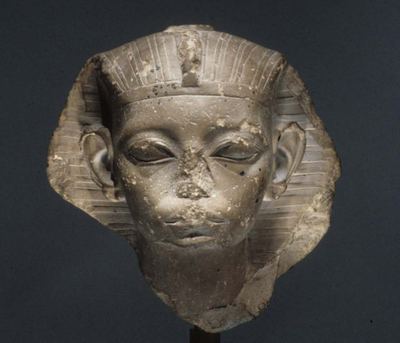
What Head of a King, possibly Amememhat IV wears is a headdress called the nemes. Stripes run across the brow, and lappets hang down on either side. Only the king could wear it, so even without a name there is no doubt that this is the head of a king, and it is also the mark you meet most often in sculptures of Egyptian kings.
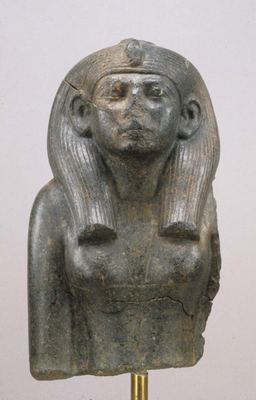
A Royal Woman declares her status with a cobra. The cobra on the brow was likewise an ornament permitted only to royalty, so this woman must have been either a queen or a princess. Her nose and mouth are broad, and she wears a long wig divided into three sections. The black stone bust has broken away below the chest, yet a single trace of the cobra ornament left on the brow lets us guess who she was.
Symbols such as the crown and the cobra stand guard in the place where the name has been erased.
Lined faces and smooth faces
Without a name, you might think the date would be unknown too, but that is not necessarily so. Egyptian sculpture had fashions for depicting faces in each period, and these let us estimate the approximate time.
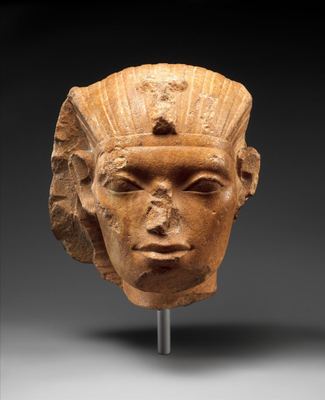
In Head of a King (quartzite), what strikes you first is the tension around the mouth and the sagging under the eyes. Like the portraits of Senwosret III and Amenemhat III, kings of this time were carved with serious, aged faces. That is why, even without a label, the wrinkles and expression alone lead us to place it in the late 12th Dynasty, that is, after Senwosret III.
Head of a King, possibly Amememhat IV follows a different current. The faces of kings in this period are said to have been moving past the lined expression of Senwosret III and back toward something younger and softer, and the impression of this head touches on that. A stern, aged face was fashionable for a while, and then the young, smooth face returned. Reading the course of a dynasty from a single face is one of the pleasures of looking at Egyptian sculpture.
A king’s face on a lion’s body
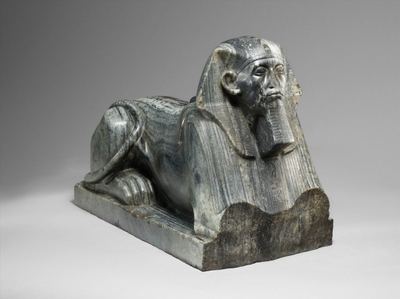
Senwosret III as a Sphinx is the only one of the four whose king has been identified by name. The face retains the lined, serious expression characteristic of Senwosret III, so it is interesting to set it side by side with other face sculptures of the same king.
Because this sphinx keeps its name, it gives us a standard for comparison. We can first confirm what Senwosret III looked like, and then consider whether the nameless heads resemble that face. The material is a single block of gneiss in which dark gray and green mix like stripes. In an age when only bronze tools were available, simply shaping such hard stone this smoothly must have been a display of skill.
Sort by the color of the stone first
All four are compositions with a face or figure at the center on single-colored stone, so the approach to assembling them is similar. Sorting first by the color of the stone makes things much easier. Limestone is light, quartzite has a reddish tinge, gneiss has gray and green stripes, and gabbro is black, which makes it easy to separate shadows from highlights. The stripes of the nemes run in slightly different directions on each piece, so follow that direction to find neighbors. Broken edges, such as the tip of the nose or below the chest, have distinct shapes and actually make good reference points. In a sculpture with a body, such as the sphinx, the grain of the stone flows along the curves of the mane and body, so use that grain as a clue. For the heads, 24–48 pieces is about right, and for the sphinx, with its more complex form, 48–100 pieces.
What outlasted the names
Put the four together and a strange paradox appears. Egyptian kings carved their names in cartouches and wrote them again and again on temple walls. Yet now, 3800 years later, many of those names have broken off the sculptures or worn away. What survives are forms such as the headdress, the cobra, and the facial expression, and those forms still tell us what rank these people held.
It is common for the maker’s name not to survive. I talked about that in what “unknown artist” means, but these four go a step further and have lost even the names of the people they depict. The sculptures from the temple of Amenemhat I continue in sculptures from a ruined temple, and the other conventions Egyptian sculpture followed in the conventions of Egyptian sculpture. Still, the thought that lingers longest in front of these four is a single one. Names vanish no matter how carefully they are carved, yet a single headdress and a single cobra have endured for 3800 years.