A Sunday on La Grande Jatte
Parisians spending a Sunday afternoon on an island in the Seine: the landmark work of pointillism, painted over two years in millions of dots of color. Full commentary ↓
Couldn't load the puzzle image.
Turn on piece outlines to see piece positions on this picture too
Drag the pieces into place · When zoomed in, drag an empty spot to move around
You can also play with a keyboard — Tab to the board, thenSpace pick a piece, Arrow keys move it (with Shift for small steps),Esc deselect, R rotate a piece (Shift+R the other way)
A Sunday on La Grande Jatte is an oil painting by Georges Seurat (1884–86) in the collection of The Art Institute of Chicago. It measures 207.5 × 308.1 cm.
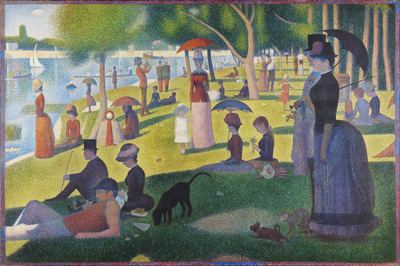
In the pictureParisians sit or stand on the grassy riverbank. At the front right are a woman holding a parasol and a man in formal dress, with a monkey and a dog at their feet. On the left a man lies smoking, and in the middle a girl in white faces straight out. There are rowboats and sailboats on the river. Everything is made of small dots of color, so up close you see only dots, and from a distance they become a scene. It is a large work, 3 meters wide.
BackgroundSeurat painted it from 1884 to 1886. He took from scientific theory the method of not mixing colors on the palette but placing dots of pure color side by side so that they mix in the viewer's eye, and this painting was his first attempt at it on a large scale. When it hung in the last Impressionist exhibition in 1886, people laughed, but it became a milestone that showed where painting after Impressionism would go. The statue-like stiffness of the figures is also intentional.
Puzzle tipAs a puzzle, the pointillism makes all the pieces look alike when they are shown small, so zooming in is essential. Anchor the large figures first, such as the woman with the parasol, the man in formal dress and the girl in white, and divide the grass into sunlit areas (bright yellow-green) and shaded areas (dark blue-green). The river is painted in horizontal dabs and the grass in vertical ones, which tells them apart. It suits 300 pieces well, but takes time.
- Classification
- Painting
- Medium
- Oil on canvas
- Dimensions
- 207.5 × 308.1 cm
- Credit line
- The Art Institute of Chicago, 1926.224
Source: The Art Institute of Chicago ↗
In these collections: Masterpieces Everyone Knows
Stories about this work
- 17 Must-See Paintings at the Art Institute of Chicago, from Seurat's Dots to American Gothic
Seurat's A Sunday on La Grande Jatte, Caillebotte's Paris Street; Rainy Day, Van Gogh's The Bedroom and Grant Wood's American Gothic. The stories of 17 must-see paintings at the Art Institute of Chicago, what to check before you go, and how to meet them first as puzzles.