Diana
Diana, goddess of the hunt, emerges from the forest with her bow, hound and nymphs, a mythological painting by Diaz, painter of the Barbizon woods. Full commentary ↓
Couldn't load the puzzle image.
Turn on piece outlines to see piece positions on this picture too
Drag the pieces into place · When zoomed in, drag an empty spot to move around
You can also play with a keyboard — Tab to the board, thenSpace pick a piece, Arrow keys move it (with Shift for small steps),Esc deselect, R rotate a piece (Shift+R the other way)
Diana is an oil painting by Narcisse-Virgile Diaz de la Peña (1849) in the collection of The Metropolitan Museum of Art. It measures 118.1 × 70.5 cm.
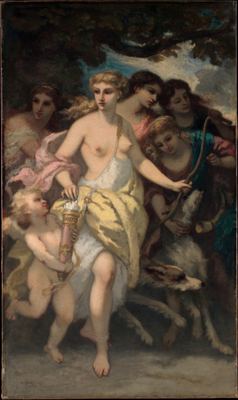
In the pictureThe blond goddess, draped in yellow cloth and holding a bow, walks out of the forest. Four nymphs follow behind her; at the lower right is a gray hunting dog, and at the lower left a cherub holding a quiver. The background is dark foliage, and only the figures' skin and clothing are light.
BackgroundDiana is the Roman goddess of the hunt and the moon. Narcisse-Virgile Diaz de la Peña was a Barbizon School painter famous for his landscapes of the Forest of Fontainebleau, but for the Salon he often submitted paintings like this one, showing mythological figures in the woods. His way of setting light skin against a dark forest is the same as the way the sky breaks through between the trees in his landscapes.
Puzzle tipFitting the figures' flesh-colored pieces, the yellow cloth and the gray dog first establishes the vertical axis of the picture. Divide the dark foliage pieces into those mixed with sky light from the upper left and those that are purely dark, and fill them in from the edges. It is a tall picture, so it is easiest to work from top to bottom.
- Artist
- French, Bordeaux 1808–1876 Menton
- Classification
- Paintings
- Medium
- Oil on canvas
- Dimensions
- 118.1 x 70.5 cm
- Credit line
- Bequest of Collis P. Huntington, 1900
Source: The Metropolitan Museum of Art ↗
In these collections: Animals in Masterpieces
Stories about this work
- How to Make a Masterpiece Puzzle a Day a Habit
Big goals tend not to last. A low-pressure way to keep going, and what happens when you finish all of the more than 300 works.
- Two Paintings Where Diaz, Painter of the Fontainebleau Forest, Left the Woods
Even a painter who spent his life painting the Fontainebleau forest on one leg had his exceptions. Diaz seen through a myth outside the forest and a close-up of a single tree.
- Why Dogs and Horses Turn Up So Often in Old Master Paintings
Animals in old paintings were both decoration and symbol: the dog for loyalty, the horse for status and authority, the bird for freedom and the soul. Small supporting players you find while doing the puzzle.