Arrival of the Normandy Train, Gare Saint-Lazare
A locomotive pulls in, puffing steam, under the iron roof of the Gare Saint-Lazare in Paris: one of the series Claude Monet painted inside the station. Full commentary ↓
Couldn't load the puzzle image.
Turn on piece outlines to see piece positions on this picture too
Drag the pieces into place · When zoomed in, drag an empty spot to move around
You can also play with a keyboard — Tab to the board, thenSpace pick a piece, Arrow keys move it (with Shift for small steps),Esc deselect, R rotate a piece (Shift+R the other way)
Arrival of the Normandy Train, Gare Saint-Lazare is an oil painting by Claude Monet (1877) in the collection of The Art Institute of Chicago. It measures 59.6 × 80.2 cm.
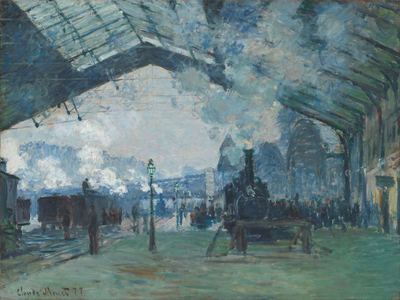
In the pictureThe station's iron-and-glass roof covers the top of the picture, and through the opening beneath its lower edge, shaped like an inverted V that peaks in the middle, a hazy sky and the buildings across the way can be seen. Right of center, a black locomotive stands facing forward, and white steam rising from its smokestack fills the space under the roof. On the platform to the right of the locomotive, people form a dark crowd, and on the tracks to the left are freight cars and a few people standing on the rails. Near the middle stands a single green lamppost, and the signature and the number 77 are written in the lower left corner.
BackgroundIn early 1877 Monet took a studio near the Gare Saint-Lazare and got permission to paint inside the station. That year he produced a dozen or so paintings of the station from various vantage points, and some of them hung in the third Impressionist exhibition in April. Other paintings from the series are scattered among the Musée d'Orsay in Paris and other collections. The Gare Saint-Lazare is the station for trains between Paris and Normandy, and Le Havre, the port city where Monet grew up, is on this line. What Monet set out to paint, it is said, was less the trains than the shifting steam and light beneath the glass roof.
Puzzle tipStart with the clearly defined shapes. The black locomotive and the wooden frame in front of it, the green lamppost, and the dark blue ironwork of the roof serve as references. The roof touches the top border, so it is good to fit it together with the border. The hard parts are the steam and the sky. The sky is close to a pale cream, while the steam gathers in rounded masses of white and bluish gray, so sort pieces with clumped brushwork as steam and flat pieces as sky. The ground is nearly a solid blue-green, so leave it for last. 100 pieces suits it.
- Classification
- Painting
- Medium
- Oil on canvas
- Dimensions
- 59.6 × 80.2 cm
- Credit line
- The Art Institute of Chicago, 1933.1158
Source: The Art Institute of Chicago ↗
Stories about this work
- 17 Must-See Paintings at the Art Institute of Chicago, from Seurat's Dots to American Gothic
Seurat's A Sunday on La Grande Jatte, Caillebotte's Paris Street; Rainy Day, Van Gogh's The Bedroom and Grant Wood's American Gothic. The stories of 17 must-see paintings at the Art Institute of Chicago, what to check before you go, and how to meet them first as puzzles.