Aristotle with a Bust of Homer
A philosopher in a gold chain rests his hand on a blind poet's bust, lost in thought: a late Rembrandt and the Met's most famous auction purchase. Full commentary ↓
Couldn't load the puzzle image.
Turn on piece outlines to see piece positions on this picture too
Drag the pieces into place · When zoomed in, drag an empty spot to move around
You can also play with a keyboard — Tab to the board, thenSpace pick a piece, Arrow keys move it (with Shift for small steps),Esc deselect, R rotate a piece (Shift+R the other way)
Aristotle with a Bust of Homer is an oil painting by Rembrandt (1653) in the collection of The Metropolitan Museum of Art. It measures 143.5 × 136.5 cm.
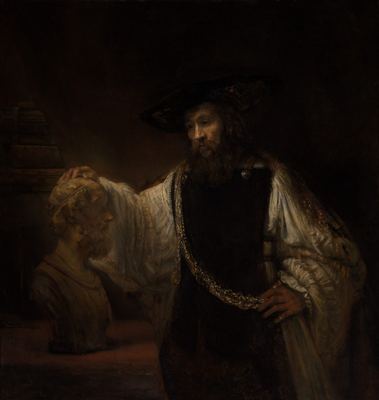
In the pictureIn the darkness, a man with a broad hat and white sleeves rests his right hand on the head of a marble bust. A gold chain hangs from his shoulder to his waist, with a medal attached. The bust is of the blind poet Homer. The man's gaze is directed not at the bust but into space, and his left hand touches the chain at his waist. The light falls only on the face, the sleeves and the bust.
BackgroundThe painting was made in 1653 on commission from Antonio Ruffo, a Sicilian nobleman. Aristotle was the teacher of Alexander the Great, and the chain and medal around his neck are interpreted as gifts from Alexander. Some read it as the philosopher weighing worldly wealth and honor (the chain) against eternal poetry (Homer), others as Rembrandt himself, hard pressed by commissions. In 1961 the Metropolitan Museum of Art bought it for what was then the highest price ever paid for a work of art at auction, and it made the news.
Puzzle tipAs a puzzle, darkness covers more than half the picture. First join the bright pieces, the white sleeves, face, bust and gold chain, to build the figure's shape, then turn on the preview and sort the dark pieces by fine differences of brown, black and reddish tones. The line of gold dots along the chain is a good clue.
- Artist
- Dutch, Leiden 1606–1669 Amsterdam
- Classification
- Paintings
- Medium
- Oil on canvas
- Dimensions
- 143.5 x 136.5 cm
- Credit line
- Purchase, special contributions and funds given or bequeathed by friends of the Museum, 1961
Source: The Metropolitan Museum of Art ↗
In these collections: Masterpieces Everyone Knows
Stories about this work
- Five Masterpieces by Vermeer, Rembrandt and Bruegel as Jigsaw Puzzles
Two Vermeers, two Rembrandts, one Bruegel. From a morning where nothing happens to the face of a bankrupt painter, why the Low Countries masters turn into a battle with dark pieces when you solve them as puzzles.
- 12 Must-See Paintings at the Met in New York, Meet Them First as Puzzles
Washington Crossing the Delaware, Madame X, Bruegel's Harvesters, Vermeer and Rembrandt, Van Gogh's wheat field and Hokusai's wave. Twelve must-see paintings at the Met, how to check whether they are on view, and how to preview them as puzzles.