Bacchanal
A nymph seized by a satyr, putti riding a billy goat and a statue on a pedestal in a single frieze-like strip: a 17th-century etching by Brebiette. Full commentary ↓
Couldn't load the puzzle image.
Turn on piece outlines to see piece positions on this picture too
Drag the pieces into place · When zoomed in, drag an empty spot to move around
You can also play with a keyboard — Tab to the board, thenSpace pick a piece, Arrow keys move it (with Shift for small steps),Esc deselect, R rotate a piece (Shift+R the other way)
Bacchanal is a print by Pierre Brebiette (1600–1642) in the collection of The Metropolitan Museum of Art. It measures 9.4 × 24.5 cm.
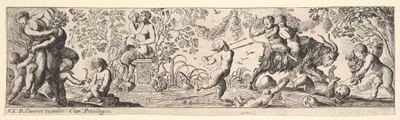
In the pictureThe scene runs in a single row across a narrow, wide picture 9.4cm high and 24.5cm wide. At the far left a satyr clasps a struggling woman as putti cling to her legs. Beside them sits a child holding a bird on a string. In the middle stands a statue of two embracing figures on a pedestal, and below it water flows from a toppled jar to form a pool with reeds and a duck. On the right, two putti with bows take aim at a child fleeing on a large billy goat, and other children tumble about in front. The child at the far right holds a satyr mask.
BackgroundPierre Brebiette (about 1598–1642) was a painter and printmaker active in Paris in the first half of the 17th century who left a number of etchings of festivals from ancient myth and children's games in long horizontal strips. The Met's record places this plate in the set Bacchanals and Children's Games and notes that it is a trimmed impression. Brebiette's signature is at the bottom center, and at lower left is the inscription "F.L.D. Ciartres excudit Cum Privilegio," meaning it was printed under a publishing privilege by François Langlois, the Paris print publisher known as Ciartres. It was purchased with the Pulitzer Bequest Fund in 1917.
Puzzle tipIt is more than three times as wide as it is tall, so the pieces are very flat and the figures small. Find the black fur of the billy goat, the darkest area, the body of the satyr on the left and the statue's pedestal in the middle first to set the order from left to right. Join the gaps with the children's round bodies and the pieces with flying arrows. The two inscriptions along the bottom edge serve as a baseline, and the leaves and flying birds at the top are filled in last. 24 or 48 pieces is about right.
- Artist
- French, Mantes-sur-Seine ca. 1598–1642 Paris
- Classification
- Prints
- Medium
- Etching
- Dimensions
- 9.4 x 24.5 cm
- Credit line
- Purchase, Joseph Pulitzer Bequest, 1917
Source: The Metropolitan Museum of Art ↗
Stories about this work
- A Bacchanal and the Blind Goddess of Fortune by the 17th-Century Printmaker Brebiette
Bacchus's rowdy revels and the blindfolded goddess of fortune. A reading of two mythological prints by the little-known French printmaker Pierre Brebiette.