'Barbarous Entertainment', a blind guitarist on the horns of a bull
A blind musician, clutching his guitar, flails as he is lifted on the horns of a black bull: Goya's Barbarous Entertainment, etched in 1800–04. Full commentary ↓
Couldn't load the puzzle image.
Turn on piece outlines to see piece positions on this picture too
Drag the pieces into place · When zoomed in, drag an empty spot to move around
You can also play with a keyboard — Tab to the board, thenSpace pick a piece, Arrow keys move it (with Shift for small steps),Esc deselect, R rotate a piece (Shift+R the other way)
'Barbarous Entertainment', a blind guitarist on the horns of a bull is a print by Goya (1800–1804 (published 1828–67)) in the collection of The Metropolitan Museum of Art. It measures 17.7 × 21.9 cm.
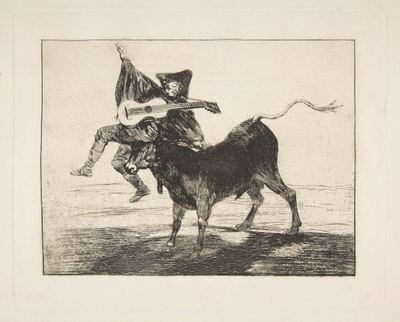
In the pictureOn the right of a wide horizontal plate, a black bull stands braced on all four legs with its head lowered, and on its horns a man in a cape is lifted as if sitting astride them. The man clutches a guitar to his chest, kicks both legs out into the air to the left, and raises one arm high along with his cape. Under his broad-brimmed hat, his eyes are closed. The bull's tail curves up toward the upper right. The background is a light area with only a few horizontal lines, and a dark shadow lies across the ground. Beyond the plate's border line, a wide margin of paper remains.
BackgroundAs the title says, this plate shows a cruel game in which a blind guitar player is set before a bull as a laughingstock. Though there is a bull, it is not part of the Tauromaquia (1816) series recording bullfighting techniques; according to the Met's record, it was made in 1800–1804, between Los Caprichos (1799) and that series. It was not printed in Goya's lifetime, and impressions were made between 1828 and 1867. The techniques are etching, aquatint and drypoint, and at 17.7×21.9 cm the plate is much larger than Goya's prison prints. The sheet had been folded, and opened out it measures 45.3 cm across. It entered the collection in 1918 through the Rogers Fund.
Puzzle tipThe black body of the bull is the largest mass in the picture, so fit it first, then attach the head and the musician on its horns. The bright body of the guitar and the white curve of the bull's tail mark the upper left and right. The man's two legs and shoes stretching to the lower left are also easy pieces to miss. The ground shadow darkens toward the right, and the light background and margin are filled in last, using the plate's border line as a guide. 48 pieces is about right.
- Artist
- Spanish, Fuendetodos 1746–1828 Bordeaux
- Classification
- Prints
- Medium
- Etching, aquatint, drypoint on laid paper
- Dimensions
- 17.7 × 21.9 cm
- Credit line
- Rogers Fund, 1918
Source: The Metropolitan Museum of Art ↗
Stories about this work
- The Prison Prints and Cruel Spectacle Goya Never Released in His Lifetime
Not the bullfight prints, and not Los Caprichos. Two prison prints and a cruel spectacle that came out only after Goya's death, plus one nightmare from his last years.