A Bacchanal and the Blind Goddess of Fortune by the 17th-Century Printmaker Brebiette
Published
Pierre Brebiette. The museum’s records hold only a single line: “born about 1598 in Mantes-sur-Seine, died 1642 in Paris.” He was a 17th-century French printmaker, but few people know his name. Set two of his prints side by side and their moods are opposites. One is a riotous drinking party; in the other, gods offer treasure to the goddess of fortune.
| Work | Date | Size | Subject |
|---|---|---|---|
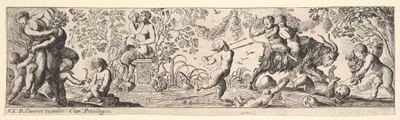
| Bacchanal | 1600–1642 | 9.4 × 24.5cm | A festival around the god of wine |
| Jupiter, Pluto and Neptune Offering their Riches to Fortune | 1624 | 25.2 × 15.6cm | The gods and the goddess of fortune |
Designs for chests and wall panels
 Solve this painting as a puzzle → about 5 minutes on Easy
Bacchanal lines up satyrs, nymphs, and cherubs across an absurdly wide horizontal format. Brebiette, who worked in Paris in the first half of the 17th century, left a number of etchings that spread festivals from ancient myth out at length like a frieze, and such prints are said to have been used as models for furniture and wall decoration.
So this sheet was likely printed not so much to be hung on a wall and admired as to be a design that a carpenter or craftsman kept spread out nearby while carving patterns into a chest or wall panel. The cast plays its set roles, too. The goat-legged satyrs, the frolicking nymphs, the god of wine seated under a tree, and even the goat and the cherubs faithfully follow the iconography of classical myth.
Three gods before the blindfolded goddess
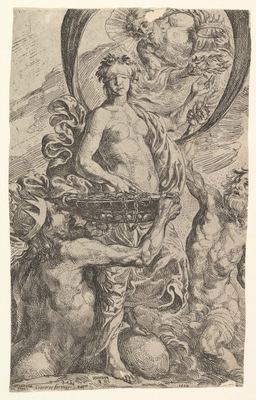
Move on to Jupiter, Pluto and Neptune Offering their Riches to Fortune and the air grows heavy. A blindfolded woman stands on a cloud, looking down at a treasure chest held up by two men.
It is an allegory in which Jupiter, ruler of the sky, Pluto of the underworld, and Neptune of the sea each offer their wealth to Fortuna, the goddess of fortune. Fortuna’s covered eyes mean that luck is neither fair nor foreseeable. The most powerful beings in myth, who divided the world into three among themselves, kneel before that blind goddess. The point is that even the gods are helpless before fortune. It is a moral allegory of a kind common in 17th-century Europe, dressing in mythological clothing the idea that human fate depends on chance, regardless of ability or rank.
Two emotions from the same hand
Put the two side by side and you can see how widely Brebiette ranged. There is the commotion of wine, dance, and tangled bare bodies, and there is a calm reflection on a fate to which even the gods submit. Yet the line is the same. Finely drawn lines and swirling clouds are something like habits of Brebiette’s prints, so the same hand can be felt both in the sky of Fortuna and in the dizzying crowd of Bacchanal.
His is not a widely known name like Rembrandt or Goya. The surviving record amounts to little more than his birthplace and the period he was active. Still, the two prints show how myth seeped into people’s lives in 17th-century France. One became a design for decorating furniture, and the other spread as a picture carrying a lesson. The fact that the artist’s name has faded does not erase the fact that these pictures were part of the households and thoughts of people at the time.
Sorting black-and-white lines by density
Both are prints made only of black-and-white lines, so the density-sorting method used in the Degas and Lautrec drawings works just as well. Bacchanal has such a wide format that the pieces are flat and the figures small. Pick out the figures’ dark hair and the dark parts of the tree first and place them in order, then fill in the pieces that are only white paper starting from the top and bottom edges. 24 or 48 pieces is about right.
With Fortuna, it is easier to grab hold of the shapes. Assemble the woman’s light body, the two men’s faces, and the treasure chest first. Leave the clouds at the top and the curves of the eagle for later, and fill in the dark pieces with dense lines while checking them often against the preview. About 48 pieces suits this one. Both prints have small lettering engraved at the bottom, so once you find those pieces, the orientation of the picture falls into place at once.
Compared with Dietrich, who imitated many painters’ styles, Brebiette stands on the opposite side. He did not borrow anyone else’s hand; with his own hand alone he engraved both revelry and resignation. As you piece together two prints more than 300 years old, you realize that the imagination of a man who left behind only a single line about himself was wider than you might think.