Stairway and balcony, study for "Interior of the Metropolitan Museum of Art when in 14th Street"
A stair rail turning twice as it climbs, an oval portrait frame and two columns below: Waller's pencil-and-chalk study of the museum's stairway in its 14th Street days. Full commentary ↓
Couldn't load the puzzle image.
Turn on piece outlines to see piece positions on this picture too
Drag the pieces into place · When zoomed in, drag an empty spot to move around
You can also play with a keyboard — Tab to the board, thenSpace pick a piece, Arrow keys move it (with Shift for small steps),Esc deselect, R rotate a piece (Shift+R the other way)
Stairway and balcony, study for "Interior of the Metropolitan Museum of Art when in 14th Street" is a drawing by Frank Waller in the collection of The Metropolitan Museum of Art. It measures 34.6 cm × 24.8 cm.
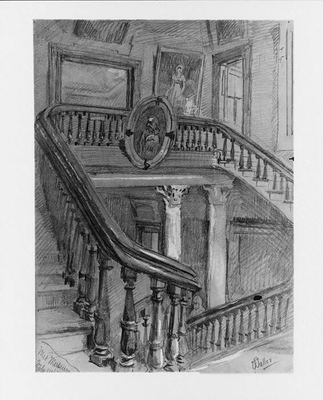
In the pictureFrom the lower left, a banister with a thick handrail curves upward, turns at the landing, and bends again to the upper right to continue to the floor above. At the middle of the landing railing hangs an oval frame holding the face of a bearded man, and below it stand two columns with decorated capitals. On the upper wall a painting of a woman in white and a large window can be seen, and at lower right there is another short railing. Each baluster is drawn in its turned shape. There is a signature at lower right and a short note at lower left, and no one is climbing the stairs yet.
BackgroundIt is undated, but it appears to belong to a group of interior studies Waller drew around 1879–80, just before the museum left 14th Street. Because the museum occupied a rented mansion, a large staircase like this was the passage connecting the upper and lower galleries, and the walls were also used for hanging pictures. This sheet is the stage at which the curve of the railing, the columns and the place of the frame were first worked out in graphite and chalk, and it measures 34.6×24.8cm. This site separately has the 1880 version, which redraws the same stairway in India ink wash and adds a woman climbing the stairs, so placing them side by side lets you compare how the composition was refined.
Puzzle tipSimilar balusters repeat in rows and are easy to confuse. Join the curve of the darkest, thickest handrail first to set up the skeleton of the picture, and fix the center with the oval frame in the middle and the two column capitals below it. Tell the balusters apart by thickness: the ones at front lower left are thickest, and those on the upper floor are thin. Place the straight pieces of the frame and window on the upper wall next, and fill in the stair treads at lower left and the outer white border last. 48 pieces is about right.
- Artist
- American, New York 1842–1923 Morristown, New Jersey
- Classification
- Drawings
- Medium
- Graphite and chalk
- Dimensions
- 34.6 cm x 24.8 cm
- Credit line
- Rogers Fund, 1912
Source: The Metropolitan Museum of Art ↗
Stories about this work
- Four Sketches by Frank Waller of the Met in Its 14th Street Days
Among this site's drawings are sketches of The Metropolitan Museum of Art on 14th Street, before it moved to its present building on Central Park.