What to Know Before Your First 300-Piece Puzzle
Published · updated
Most people who have been comfortable up to 100 pieces are thrown when they click 300. The screen fills with pieces, and each one shrinks to the size of a fingernail.
Time does not scale with the number of pieces
Three times the pieces seems like it should mean three times the time. In practice it takes longer. To find the match for one piece you have to scan the remaining pieces, and the number of pieces to scan triples as well. If you tried every possible pair with no idea of the matches, the number of attempts would be proportional to the square of the number of pieces. If 100 pieces takes around 5,000 tries, 300 pieces takes around 45,000, nine times as many. In reality, sorting by color and dividing into sections cut this cost substantially, so it does not reach nine times. Still, the direction is the same: it is much heavier than three times.
The “about” in “about 300 pieces,” and pieces the size of a fingernail
The “about” in “Expert · about 300 pieces” is not an empty word. Because the grid is laid out to match the picture’s proportions, the actual piece count varies within ±25% of the label. Dawn is 19×15 for 285 pieces, The Edge of the Woods is 20×16 for 320 pieces, and the wide Defense of Champigny is 23×13 for 299 pieces. The exact count appears in the “pieces” item at the top of the screen.
The pieces get noticeably smaller. On a laptop screen where the canvas is about 1000px wide and 600px tall, an Easy piece is in the 70px range on a side, while an Expert piece is in the mid-20px range. When there is not enough area to spread the pieces out, the workspace becomes larger than the screen and some pieces stay off-screen. Get into the habit of dragging an empty spot to move the view, and checking the whole layout now and then with the zoom-out button.
The dotted lines on the preview change too. The dotted lines are drawn at most eight to an axis so they do not hide the picture, so at 100 pieces one cell holds one or two pieces, and at 300 pieces it is usually 3 pieces across and 2 down. If you treat one dotted cell as one section, it is easy to match it to the dense grid on the board.
On screens 640px wide or narrower, or on touch devices 1024px wide or narrower, 300 pieces is not an option at all. The pieces are too small to pick up with a finger. Take this challenge on a laptop or desktop.
Finish section by section, one dotted cell at a time
“Complete 300 pieces” is too distant to serve as a goal. Divide the large masses as in the order for sorting pieces, then mark out sections based on the dotted cells and finish one section at a time. For The Defense of Champigny, it divides into about four sections: a little over 60 pieces of sky at the top, the white wall on the left, the mansion and trees on the right, and the soldiers at the bottom. Each time you finish a section, the progress percentage at the top rises noticeably, so it also works as a checkpoint along the way.
There is no need to strain to finish in one go, either. Your progress is saved automatically in this browser every time you move a piece, and it is kept separately for each difficulty. The clock starts the moment you move the first piece and stops when you leave the tab, and there is a pause button for when you step away. When you open the same puzzle again, it opens at the difficulty you were last playing, so your game carries on where it was. Taking a break is effective when you are stuck, so splitting a puzzle into sessions often makes the total time shorter. How best to continue when solving over several days is covered separately in how to solve a 300-piece puzzle over several days.
Half of a first 300-piece puzzle is choosing the picture
The higher the piece count, the better a picture with detail spread evenly across the whole surface. Every piece should have at least one clue. Areas close to a single color turn into clueless pieces in exact proportion to the space they occupy. If a third of the picture is sky or wall, that alone is 100 pieces.
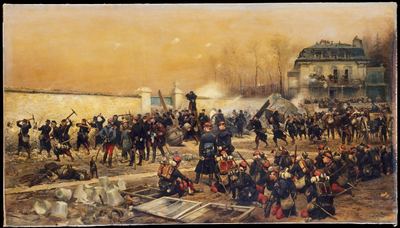 Solve this painting as a puzzle → about 5 minutes on Easy
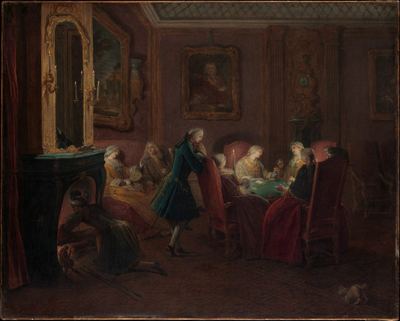
In The Defense of Champigny, the soldiers’ red trousers and blue coats and the objects scattered on the ground in the lower two-thirds give a clue in every piece. Only the sky at the top needs separate handling, and the method is the same as the strategy for puzzles with large areas of a single color. Card Players in a Drawing Room has both clues and traps. The gilded frames and mirror and the brightly lit figures around the candles are easy to tell apart, but the walls and floor, which take up most of the picture, are dark and a similar purplish tone.
For a first 300-piece puzzle, Dawn is also worth considering. The green wall decoration, the gilded frames, the inner painting and the plaster angel in the corner differ in texture to begin with, so the sections divide themselves.
Once you have finished
When you complete it, the results screen compares your time with your previous best. Solve the same picture once more, and how much faster you were than the first time is recorded as a number. Still, what stays in your memory longer is the picture rather than the record. A 300-piece picture is one you have looked at closely in every corner, so even after it is done, a single soldier or one corner of a frame is not easily forgotten.
Frequently asked questions
Does a 300-piece puzzle take three times as long as a 100-piece one?
It takes longer than that. When there are three times as many pieces, there are also three times as many pieces to scan when looking for a match. It is better to mark out sections, finish one section at a time, and solve it over several sittings.
Can I do a 300-piece puzzle on my phone?
No. On screens 640px wide or narrower, or on touch devices 1024px wide or narrower, 300 pieces does not appear as an option. The pieces become too small to pick up with a finger.
What kind of picture is good for a first 300-piece puzzle?
One with detail spread evenly across the whole picture. In The Defense of Champigny, the soldiers and objects in the lower two-thirds give a clue in every piece, and in Dawn, the wall decoration, frames, inner painting and plaster angel all have different textures, so the sections divide themselves.