Choga
A late 19th-century Indian choga of magenta silk woven with paisleys and vines in metal-wrapped thread, with a deep V neck and wide sleeves. Full commentary ↓
Couldn't load the puzzle image.
Turn on piece outlines to see piece positions on this picture too
Drag the pieces into place · When zoomed in, drag an empty spot to move around
You can also play with a keyboard — Tab to the board, thenSpace pick a piece, Arrow keys move it (with Shift for small steps),Esc deselect, R rotate a piece (Shift+R the other way)
Choga is a textile by an unknown maker (late 19th century) in the collection of The Metropolitan Museum of Art. It measures 124.5 cm.
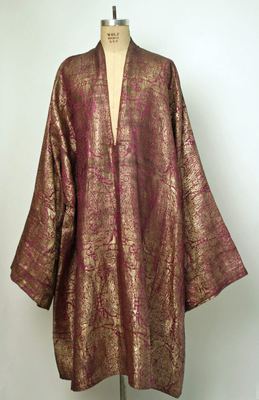
In the pictureA loose outer robe of magenta silk, densely woven in gold thread with large paisleys (teardrop-shaped motifs with curled tips) and vines, is shown on a mannequin. The neck is cut in a deep V down to near the solar plexus, with a single small fastening at its point. The sleeves flare wide from the shoulders and are wider at the wrist, and the hem falls below the knee. Where the metallic thread catches the light it looks almost gold, and in shadow it looks magenta, so the same cloth seems a different color from place to place. The paisleys appear especially large toward the bottom of the robe.
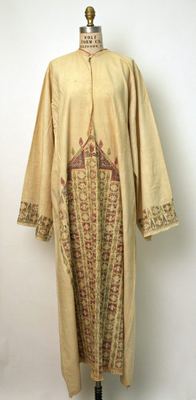
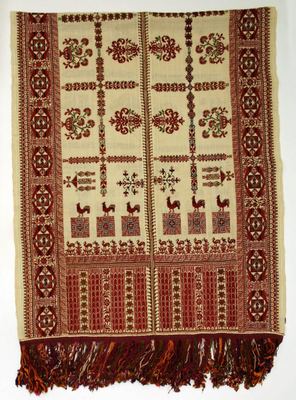
BackgroundThe Met's record describes it as an outer robe made in India in the late 19th century and lists the materials only as silk and metal wrapped thread. With no mention of embroidery, the pattern appears to have been woven into the cloth. Metal wrapped thread is made by winding a thin strip of metal around a core thread such as silk. It is 124.5 cm high, and its width with the sleeves spread reaches 203.8 cm. It was given in 1950 by the stage designer Aline Bernstein. Unlike the wool choga (86173) and the velvet choga (86177) of the same name, which have embroidered bands around their edges, this robe is made entirely from a single patterned cloth and has no separate border trim.
Puzzle tipThe same paisleys and vines repeat over the whole robe, so the pattern is little help in finding positions. Start with pieces whose shapes are distinct, such as the WOLF lettering on the mannequin's neck, the V neckline, the outer contours of the sleeves spreading to either side, and the hemline. Divide the body by the difference in brightness between the strongly golden center and the shaded sides, and judge the height of the hem by the large paisleys at the bottom. Turn on the preview; 48 pieces is recommended.
- Classification
- Main dress-Menswear
- Medium
- Silk, metal wrapped thread
- Dimensions
- 124.5 cm
- Credit line
- Gift of Aline Bernstein, 1950
Source: The Metropolitan Museum of Art ↗
Stories about this work
- Angarkha, Choga, and Kurta: Embroidery and Weaving in Indian Menswear
The kurta is a long shirt worn across South Asia, the angarkha a robe that fastens diagonally across the chest, the choga a loose open-front robe. Nine 18th–19th century garments at the Met show the differences and the embroidery.