Burnus
A hooded cream wool cloak called a burnus, worn by North African men to withstand the desert's days and nights. Full commentary ↓
Couldn't load the puzzle image.
Turn on piece outlines to see piece positions on this picture too
Drag the pieces into place · When zoomed in, drag an empty spot to move around
You can also play with a keyboard — Tab to the board, thenSpace pick a piece, Arrow keys move it (with Shift for small steps),Esc deselect, R rotate a piece (Shift+R the other way)
Burnus is a textile by an unknown maker (19th century) in the collection of The Metropolitan Museum of Art.
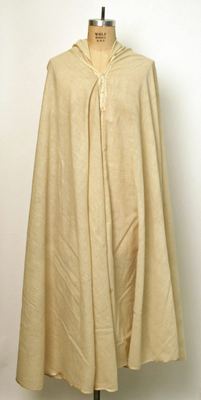
In the pictureA cream cloak draped on a mannequin falls to the floor. A pointed hood is attached at the back, the front fastens only at the neck, and there are no sleeves. The cloth is fine-textured wool mixed with silk, with almost no decoration beyond the knot at the neck and the finished edges.
BackgroundThe burnus is an outer garment worn by men in North Africa, in Morocco, Algeria, Tunisia and elsewhere. It comes from a desert climate where one must keep out daytime heat, nighttime cold and sandstorms alike, and with the hood up it can cover the head and even the face. White or cream reflects sunlight, and one made of wool this fine belonged to a wealthy person.
Puzzle tipAs it is almost a single color, it is difficult as a puzzle. Fit the pieces with shapes first, such as the mannequin's neck and shoulders, the pointed outline of the hood and the curve of the cloak's hem, then join the rest by the direction of the faint shadows cast by the folds. 24 or 48 pieces is about right.
- Classification
- Outerwear
- Medium
- Wool, silk
- Dimensions
- Overall:
- Credit line
- Gift of Jessie Franklin Turner, 1942
Source: The Metropolitan Museum of Art ↗
Stories about this work
- Why Repeating Patterns Make Islamic Costume Puzzles Harder, Not Easier
Regularly repeating embroidery patterns make a puzzle much harder, even at the same piece count. How to find the differences hidden in the repetition.